

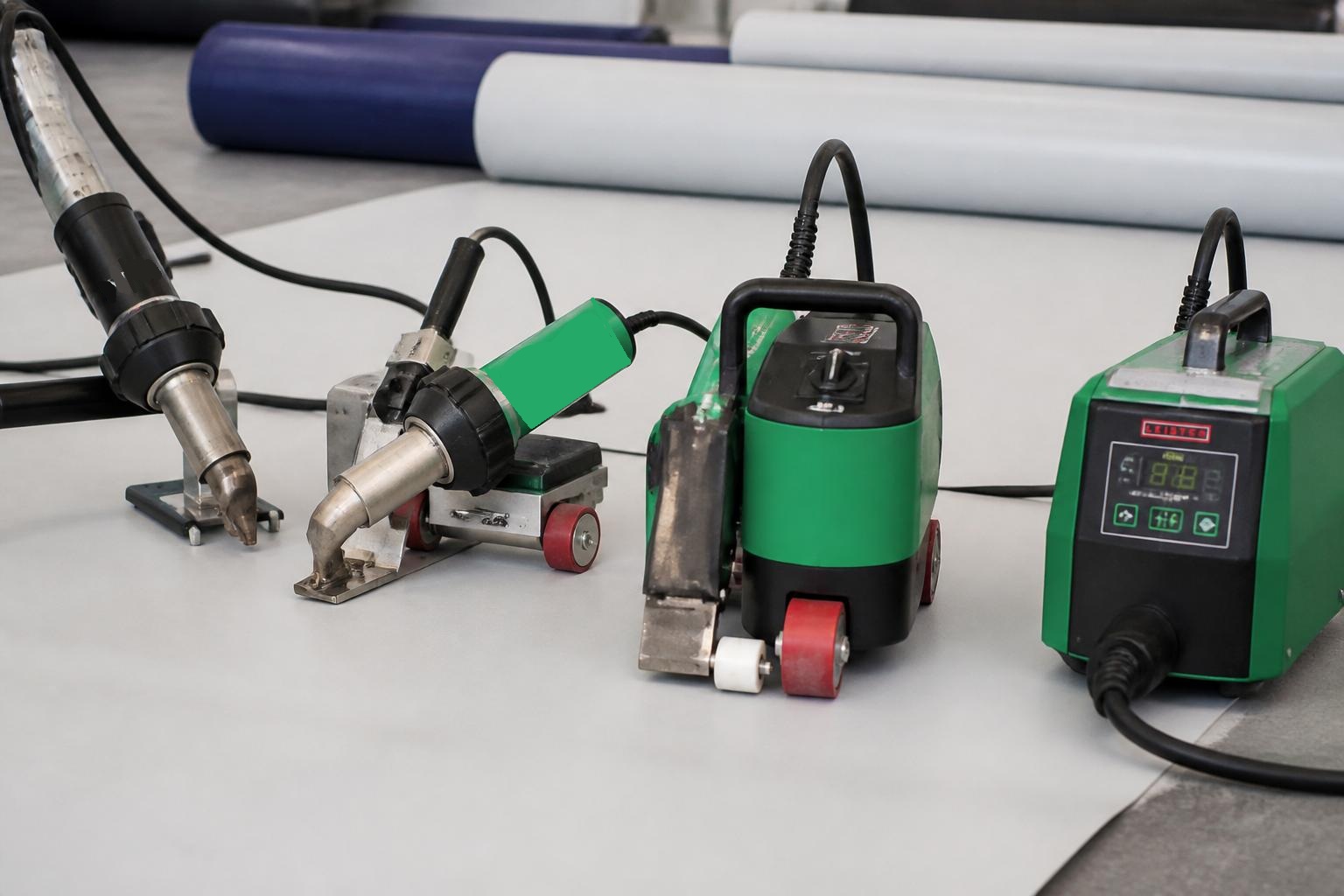
Automatic hot air overlap welding machines paired with handheld hot air guns deliver the best results for PVC roofing membranes and heavy-duty tarpaulins. For large, flat roof expanses and long tarpaulin seam runs, self-propelled automatic welders provide consistent speed, temperature control, and seam pressure that prevent water ingress. For perimeter flashings, upstands, patches, and tight corners, a dedicated 230V handheld hot air tool with a 20mm or 40mm wide-slot nozzle and a silicone pressure roller provides the necessary control for airtight, waterproof joins.
Automatic vs Handheld Welders for PVC Applications
Selecting the right machine depends on the scale of your fabrication or installation project. Commercial roofing contractors and transport cover manufacturers rely on a two-machine setup to balance speed on straight runs with precision on intricate details. When assembling your kit, reviewing the equipment required for professional PVC plastic welding in South Africa helps ensure your workshop or site team has the correct heating profiles and nozzle configurations.
Different project scopes call for specific tool configurations:
- Automatic overlap welders: Best for long continuous seams on PVC flat roofs, agricultural liners, and large truck tarpaulins, running at speeds up to 12 metres per minute.
- Handheld hot air guns: Ideal for corner details, pipe penetrations, reinforcing patches, and vertical membrane terminations.
- Wedge welders: Highly effective for thick, reinforced geomembrane liners and heavy coated tarpaulin materials where dual-track testable seams are specified.
Key Features to Look for in PVC Welding Equipment
Working on Highveld job sites in Johannesburg exposes equipment to heavy dust, high ambient temperatures, and unpredictable power supply. Your welding equipment must withstand demanding working environments while maintaining precise digital temperature regulation.
Closed-Loop Temperature Control
PVC requires an exact temperature window, typically between 450 and 550 degrees Celsius depending on material thickness, ambient temperature, and wind chill. Modern digital welding machines continuously adjust heating output to compensate for sudden voltage drops or winter wind gusts, preventing cold welds or scorched polymer.
Robust Drive Motors and Chassis Weight
Automatic roof welders require balanced chassis weighting to apply consistent pressure over uneven substrate surfaces. Integrated guide handles and laser tracking lines keep seams straight across multi-thousand square metre installations without causing operator fatigue.
Stable Voltage Handling for South African Conditions
Site power fluctuations and generator usage can damage sensitive electronic heating elements. When investing in machinery, sourcing certified PVC plastic welding tools in South Africa guarantees that tools carry proper voltage protections, local repair support, and genuine replacement ceramic heating elements.
Essential Preparation and Welding Best Practices
Even the highest-grade hot air machine cannot produce a certified waterproof seam if surface preparation is neglected. Johannesburg summer rainstorms quickly expose poor seam hygiene and weak fusion points.
Follow this checklist before running your welder over membrane seams:
- Clean both seam surfaces thoroughly with an approved PVC membrane cleaner to strip away oxidisation, transport wax, and site dirt.
- Perform a test weld on offcut material every morning and after lunch to verify peel strength and adjust settings for ambient shifts.
- Inspect silicone pressure rollers for flat spots or embedded grit that could gouge the hot membrane surface during rolling.
- Keep a brass wire brush ready to clear carbon deposits from nozzles and air intake filters during extended production runs.
Precision Solutions With Plastek
Plastek supplies industrial-grade thermoplastic welding tools, automatic seam welders, and technical accessories designed for industrial roofers, tent manufacturers, and tarpaulin fabricators across South Africa. Whether you need a dependable handheld repair unit or high-speed automatic seam equipment backed by factory-trained servicing and spare parts, click the button below to discuss technical specifications and request a competitive quote.
FAQs
What temperature should I set my welder for PVC tarpaulin seams?
Most standard PVC tarpaulins (550gsm to 900gsm) weld cleanly between 450 and 520 degrees Celsius. Start with a middle setting, run a test strip at your intended drive speed, and adjust incrementally based on material melt and bleed-out consistency.
Can I weld PVC roofing membranes during cold winter mornings in Johannesburg?
Yes, but you must compensate for low ambient temperatures. Pre-warm your machine, shield the weld area from cold Highveld wind, reduce travel speed slightly, and carry out regular destruct testing to confirm homogeneous molecular fusion.
What is the difference between hot air welding and high frequency welding for tarpaulins?
Hot air welders use heated air and mechanical pressure to fuse materials on-site or in the shop, offering portability and flexibility for repairs and field installations. High-frequency (HF) welding uses electromagnetic energy in a stationary press, which is fast for repetitive factory production but impractical for roof installations.
Why is my PVC membrane burning instead of welding properly?
Burning occurs when the temperature is set too high, the travel speed is too slow, or airflow is restricted by a blocked nozzle. Lower your heat setting by 20 to 30 degrees Celsius or increase your welding speed until you achieve a clean, smooth melt without brown discoloration or smoke.
