

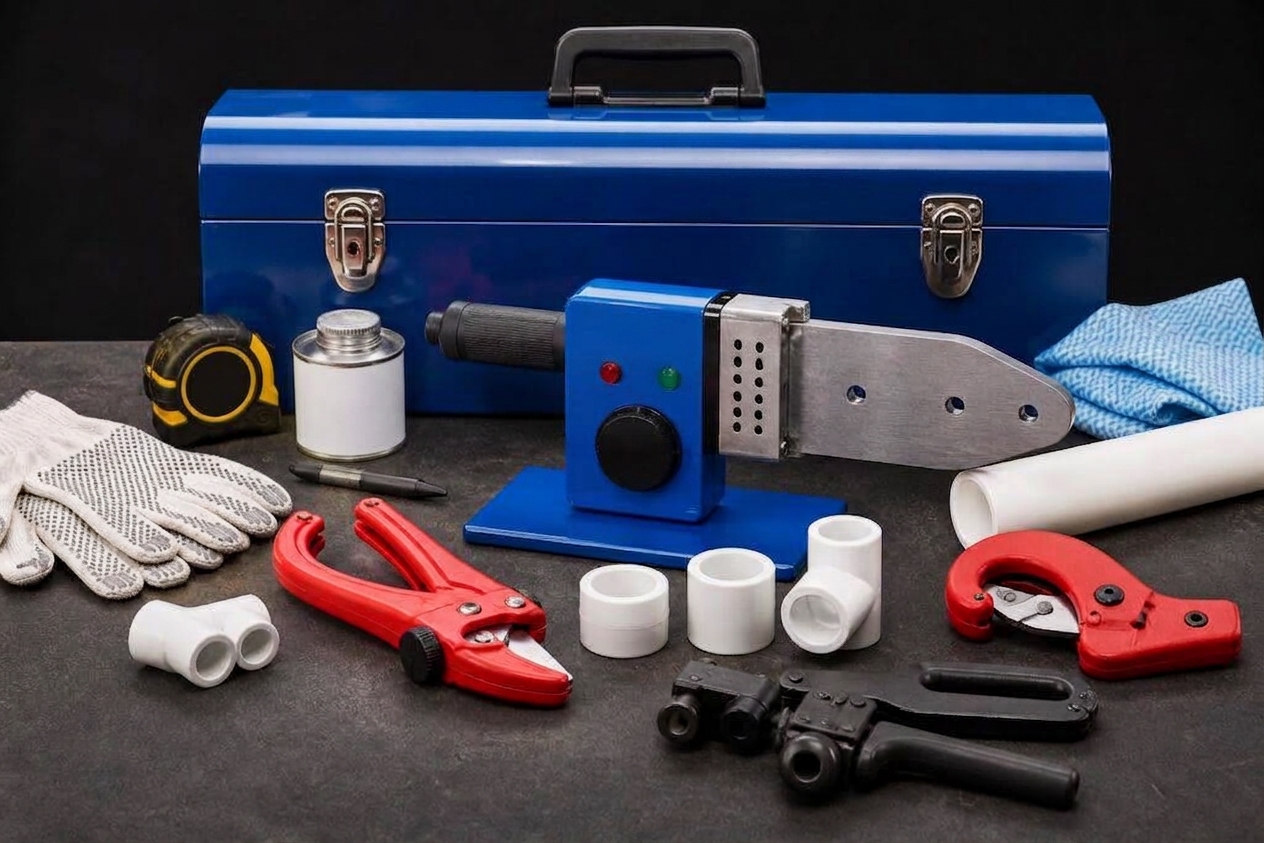
Professional PVC plastic welding in South Africa requires hot air welding guns or extrusion welders, specialised welding nozzles, digital temperature controllers, high-grade PVC filler rod, preparation scrapers, and stable power sources adapted to local conditions. Whether you are fabricating chemical storage tanks, lining containment bunds, or assembling industrial ductwork, having the correct temperature control and feed mechanism prevents brittle joints and thermal degradation.
Core Machinery for PVC Plastic Welding
Industrial PVC fabrication relies on controlled heat and mechanical pressure to fuse rigid unplasticised PVC (PVC-U) and flexible PVC sheets. Choosing the right tool depends on material thickness and joint geometry, which you can evaluate by understanding which welding methods work best for different plastics before starting a project.
- Hand-held hot air welders for precision seams, detail work, and thin sheet fabrication
- Hand extrusion welders for heavy structural tanks and thick PVC plate joins
- High-flow pre-heating blowers to bring ambient materials to ideal processing temperatures
- Heavy-duty silicone pressure rollers for consistent seam consolidation without surface deformation
Specialised Nozzles and Surface Preparation Tools
Proper joint strength starts with mechanical preparation. PVC oxidises rapidly when exposed to air and UV light, creating a thin surface layer that prevents true molecular bonding if not scraped away before heating.
Nozzle Attachments for Hot Air Guns
Speed welding nozzles feed both the hot air and the PVC filler rod simultaneously, using an integrated shoe to press the softened rod directly into the weld root. Tacking nozzles allow fabricators to align and fix plastic panels without filler wire, holding components rigid before making the final structural passes.
Surface Preparation and Scraping Tools
Clean cuts and bevelled edges ensure complete root penetration on thick PVC sheet welds. Using the right hand tools prevents uneven gaps and weak stress points in the finished fabrication.
- Rotary pipe scrapers and hand draw scrapers to remove the oxidised outer polymer layer
- V-grooving plane tools to bevel sheet edges at 60 to 90 degree included angles
- Speed welding nozzles matched to 3mm, 4mm, and 5mm round or triangular PVC welding rod
- Digital infrared pyrometers to verify weld zone temperatures across changing workshop conditions
Power Management and Site Equipment in South Africa
Welding PVC on South African job sites presents specific challenges, including grid instability and severe temperature swings between morning and midday. Utilizing heavy-duty industrial plastic welding machines with built-in voltage protection prevents heating element failures and inconsistent weld temperatures during field installations.
- Voltage-regulated generators to protect sensitive digital temperature controllers from voltage spikes during load-shedding
- Heavy-gauge industrial power cables to eliminate voltage drop over long site distances
- Mobile fume extraction units to safely capture hydrogen chloride gases released during hot-air processing
- Thermal shielding screens to protect hot PVC joints from rapid cooling caused by highveld winds
Quality Control and Testing Equipment
Industrial tanks and containment liners must meet strict safety standards to prevent environmental contamination and chemical leaks. Verifying seam integrity requires non-destructive diagnostic tools on site.
- High-frequency spark testers to locate pinholes and microscopic voids in lined tanks
- Seam probe pick tools to test the mechanical hold of overlapping membrane edges
- Calibrated tensiometers to measure the peel and shear strength of test coupon welds
Precision Solutions With Plastek
Plastek provides industrial fabricators, mining operations, and civil contractors across South Africa with proven plastic welding technology, filler materials, and technical advice. Contact the Plastek team to source reliable PVC welding machinery, replacement nozzles, and specialised fabrication accessories for your next industrial installation. Reach out to our team today by clicking the button below to get a quote, request a brochure, or find the perfect tool for your next project.
FAQs
What temperature should a hot air welder be set to for PVC?
Rigid PVC (PVC-U) typically welds between 260 and 300 degrees Celsius depending on ambient temperature, airflow rate, and welding speed. Overheating PVC causes thermal degradation, discolouration, and toxic fumes, while underheating results in cold welds with poor structural adhesion.
Can standard heat guns be used for industrial PVC welding?
Standard retail heat guns lack the precise electronic temperature control, airflow stability, and nozzle mounting systems required for structural plastic welding. Professional tools maintain stable heating elements to ensure repeatable weld quality.
Why is mechanical scraping necessary before welding PVC?
Scraping removes the thin, degraded layer of oxidised polymer on the surface of the PVC sheet. Welding over unscraped plastic traps impurities inside the joint, significantly reducing mechanical strength and leading to premature weld failure under load.
How does South African weather affect PVC welding settings?
Cold winter mornings and strong winds accelerate weld cooling, which can make joints brittle. Operators must shield their work area from draughts, adjust hot air temperatures upward slightly, and preheat thick materials to maintain uniform fusion.
