

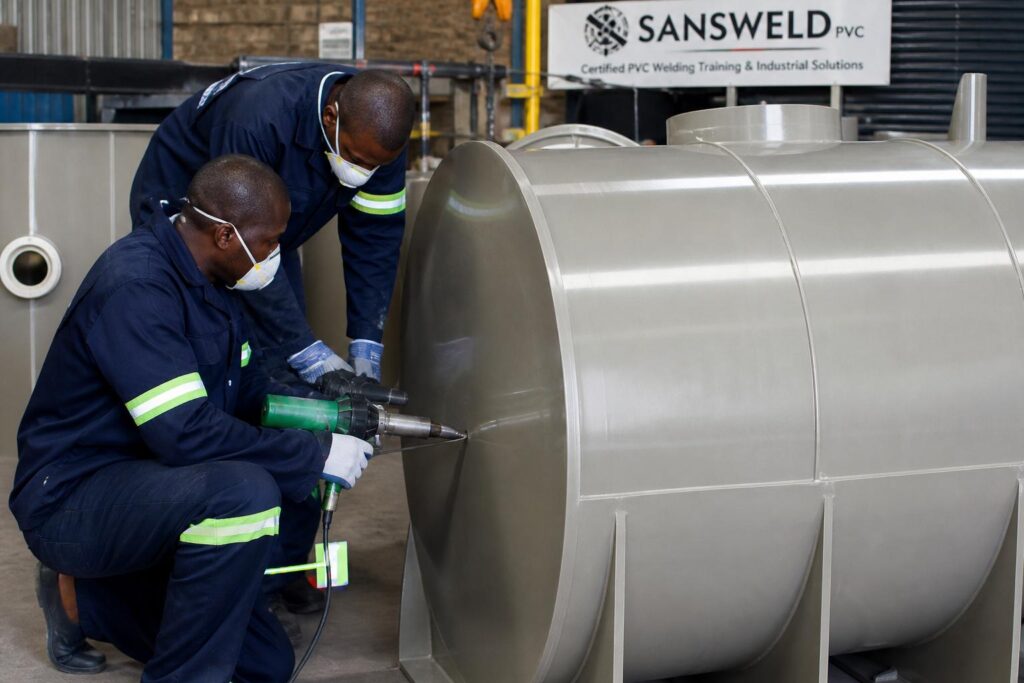
Industrial facilities across South Africa can source certified PVC plastic welding for chemical containment tanks directly through specialised thermoplastic engineering fabricators like Plastek. Securing high-integrity PVC fabrication requires certified technicians who adhere to strict DVS and SABS standards, ensuring chemical tanks withstand aggressive acids, alkalis, and heavy industrial operating conditions without seam failure.
Why Certified PVC Welding Matters for Chemical Storage
Chemical processing plants, plating shops, and water treatment works cannot afford weak joints or structural leaks. Thermoplastic tanks handling aggressive media such as hydrochloric acid, sulphuric acid, or sodium hypochlorite rely entirely on the quality of their welded seams. Understanding which welding is used for plastic helps plant managers identify the exact fabrication method required for heavy chemical containment.
Substandard welding creates micro-voids, thermal degradation, and internal stress cracks that lead to catastrophic containment failures. Working with certified fabricators guarantees that the PVC material maintains its structural integrity and chemical resistance across every seam.
Key Standards and Welding Methods
Certified industrial plastic welders operate according to rigorous German DVS (Deutscher Verband für Schweißen) guidelines, which set the global benchmark for plastic tank engineering. These standards govern pre-heating temperatures, welding speeds, and surface preparation to prevent notch stress and seam embrittlement.
- Hot gas extrusion welding for heavy-duty structural tank seams and base plates
- Hot gas speed welding using profile rods for detailed corner joints and tank liners
- Heated tool butt welding for joining thick sheet sections and pipe connections
- High-frequency spark testing to verify zero porosity across all finished welds
Evaluating Industrial Plastic Welding Providers in South Africa
When selecting a fabrication partner for chemical containment, facilities must look beyond standard sheet metal or general plastic shops. Professional plastic engineering demands dedicated facilities, calibrated temperature control systems, and industrial-grade tooling.
Top-tier fabricators deploy modern industrial plastic welding machines with digital temperature and pressure readouts to maintain strict weld parameters, even during fluctuating factory conditions. This precision ensures consistent fusion throughout thick rigid PVC (PVC-U) and chlorinated PVC (PVC-C) materials.
What to Demand From Your Welding Contractor
Before commissioning a chemical tank build or relining project, verify the contractor meets specific technical criteria:
- Documented welder certifications showing adherence to DVS 2212 standards
- Traceability records for virgin-grade, UV-stabilised PVC sheet material
- Calibrated extrusion and hot-air equipment matching material specifications
- Non-destructive weld testing procedures before delivery and installation
Common Industrial Applications for Welded PVC Tanks
Rigid PVC remains one of the most reliable and cost-effective materials for industrial containment when correctly fabricated. South African facilities utilize welded PVC tanks across a variety of demanding environments:
- Acid pickling tanks and dipping baths for galvanising and metal finishing plants
- Effluent neutralization and secondary containment bunds for manufacturing sites
- Chemical dosing and reagent storage tanks for municipal water treatment
- Fume scrubbers and ducting networks handling corrosive chemical vapours
Precision Solutions With Plastek
Plastek delivers certified thermoplastic fabrication and repair services engineered specifically for harsh South African industrial environments. Whether you need new chemical containment vessels, on-site tank modifications, or emergency seam repairs, our team provides certified workmanship built to international standards. Reach out to our team today by clicking the button below to get a quote, request a brochure, or find the perfect tool for your next project.
FAQs
What certifications should I look for in an industrial PVC plastic welder?
Look for fabricators whose technicians hold DVS 2212 certifications for thermoplastic welding. In South Africa, adherence to SANS and DVS standards ensures that welders follow precise temperature, pressure, and joint preparation protocols for chemical-grade vessels.
Can damaged PVC chemical tanks be repaired on-site?
Yes. Certified technicians can perform on-site repairs using extrusion welders or hot gas tools. The process involves grinding out cracked or compromised sections, preparing the parent material, and laying new weld beads to restore structural and chemical containment.
How is the integrity of a welded PVC tank seam tested?
Seams are tested using non-destructive methods such as high-frequency spark testing, which detects microscopic pinholes in the weld. Hydrostatic pressure testing and visual inspections under controlled lighting are also standard quality control steps.
Why is PVC preferred over polyethylene for certain chemical tanks?
Rigid PVC offers exceptional resistance to specific oxidizing agents, strong acids, and chlorine compounds where polyethylene may soften or degrade. It also provides high tensile strength and rigidity for rectangular process tanks and fume scrubbing systems.
