

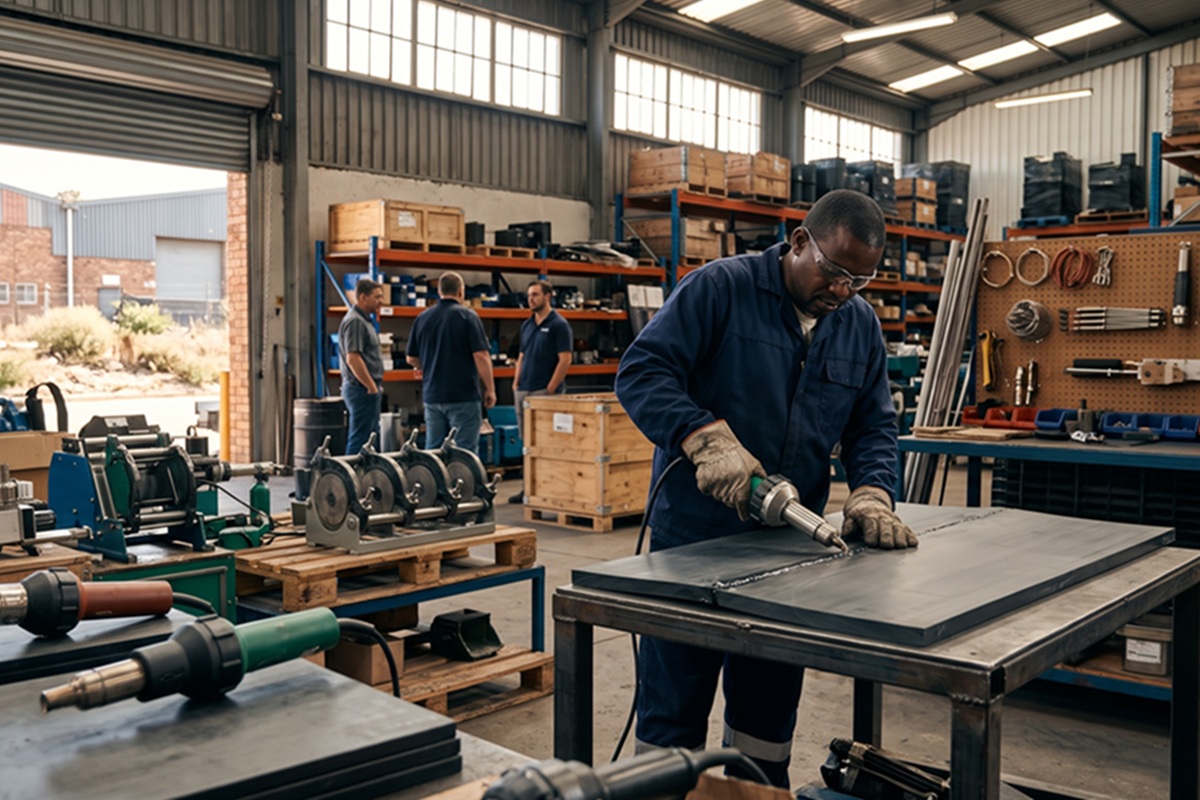
Plastek is the leading industrial supplier of plastic welding machines in Johannesburg, supplying civil engineering firms, commercial fabricators, and mining contractors across Gauteng with professional extrusion welders, hot air hand tools, and automatic geomembrane wedge welders. Located near major Witwatersrand industrial transport routes, Plastek pairs European-manufactured machinery with local technical support, original replacement elements, and routine calibration services to prevent unscheduled operational downtime.
Industrial Plastic Welding Equipment Available in Gauteng
Plastic fabrication and containment projects require distinct technologies depending on joint design, site access, and sheet gauge. Local workshops and site teams evaluate what features to look for in hot air plastic welding tools from Johannesburg suppliers to ensure consistent temperature delivery and long motor lifespans under continuous use.
Contractors across industrial nodes such as Jet Park, Alrode, and City Deep select their welding systems based on specific operational requirements:
- Handheld hot air welders engineered for detail fabrication, tank fittings, vehicle plastic repairs, and overlap seam welding on thin liners.
- Hand extrusion welders designed for heavy structural tank construction, thick HDPE plate joining, and large-diameter utility pipe fabrication.
- Automatic hot wedge and hot air welders calibrated for civil lining projects, including tailings dams, leachate reservoirs, and municipal landfills.
- Electrofusion and butt fusion machinery configured for high-integrity pressure piping networks in mining and water distribution.
Selecting Machinery for Highveld Operating Conditions
Operating hot air equipment on the Highveld presents technical challenges that standard hobbyist heat tools cannot endure. Johannesburg sits at approximately 1,700 metres above sea level, where thinner atmospheric density alters thermal convection and airflow efficiency. Combined with erratic grid power and frequent reliance on generator sets during load-shedding cycles, equipment must incorporate robust electronic controls to maintain stable temperatures.
Thermal Regulation and Voltage Stability
Sudden voltage drops and spikes from site generators can burn out unshielded heating elements. High-grade industrial welders utilize closed-loop digital controls that actively compensate for fluctuations in incoming voltage, ensuring that the plasticizing temperature remains locked to material specifications regardless of external electrical shifts.
Demanding Highveld conditions demonstrate why Swiss-made plastic welding tools outperform standard heating tools in Johannesburg sites where dust, altitude, and unstable generator feeds are everyday realities.
To avoid premature heating element burnout and ensure joint integrity under demanding field conditions, operators must adhere to standard site protocols:
- Monitor generator output voltage with an in-line meter before connecting sensitive electronic welding systems.
- Clean stainless steel air intake filters daily to stop fine mining dust and Highveld topsoil from degrading motor windings.
- Initiate mandatory tool cool-down cycles before disconnecting mains or auxiliary generator supplies.
Industrial Applications and Certified Hardware Supply
Fabrication shops and containment contractors across Gauteng depend on robust tools capable of non-stop production cycles. Engineering teams consistently research where to find heavy-duty BAK plastic welding tools Johannesburg contractors trust for harsh lining and heavy structural fabrication work.
Plastek supplies verified hardware configured to weld demanding thermoplastic polymers across multiple Gauteng sectors:
- Chemical manufacturing infrastructure, including acid pickling tanks, chemical scrubbers, and industrial drainage sumps using high-density polyethylene and polypropylene.
- Environmental and civil containment projects, including hazardous waste lining, farm dams, stormwater attenuation basins, and mining retention ponds.
- Ventilation and extraction installations, joining rigid unplasticized PVC ducting for corrosive industrial fumes.
- Logistics and bulk materials handling, rebuilding cracked transport bins, pallets, and bulk containers to restore logistics efficiency.
Plastic Welding Machines From Plastek
Plastek supplies genuine BAK technology, original spare parts, specialized welding nozzles, and complete technical services directly to industrial contractors across Johannesburg. Working with an authorized supplier ensures you receive equipment backed by local stockholding, eliminating the extended delays of international shipping when replacement ceramics, blowers, or heating elements are required. Reach out directly to discuss your fabrication or containment requirements, or submit project specifications by clicking the button below to request equipment pricing and technical assistance.
FAQs
Can I weld different plastic types together using a hot air tool?
No; thermoplastics must be joined with a matching polymer base. Polyethylene welds only to polyethylene, and polypropylene welds only to polypropylene. Attempting to weld incompatible plastics produces weak, mechanical bonds that fail under physical stress or hydraulic pressure.
How does altitude in Johannesburg affect plastic welding?
At 1,700 metres above sea level, thinner air absorbs and transfers heat differently than at coastal elevations. Hot air welding machines must move air efficiently and utilize precise closed-loop sensors to maintain exact melt temperatures despite reduced atmospheric density.
Are spare parts for plastic welding machines stocked locally in Johannesburg?
Yes; Plastek carries inventory for heating elements, motor brushes, replacement ceramics, and extrusion shoes in Gauteng, allowing contractors to service equipment quickly without waiting weeks for overseas shipments.
What power source is required to run industrial plastic welders on site?
Handheld hot air welders typically operate on standard 230V single-phase power, requiring a steady 1.6 kW to 3.4 kW supply. Large extrusion welders and automatic wedge machines often need clean 3.5 kW to 6 kW generator capacity equipped with automatic voltage regulation to prevent electronics damage.
