

Unlike metal, joining plastic requires precise polymer science to create bonds as strong as the base material. Incorrect methods lead to leaks and failure, so choosing the right technique is vital for project longevity.
It isn’t just about melting; it’s about creating a permanent, homogenous molecular bond between parts. This guide explores primary welding methods to help you select the best fabrication techniques for your needs. As South Africa’s specialists, we ensure your specific project achieves a reliable and professional finish.
Understanding Plastic Welding: More Than Just Melting
Plastic welding uses heat, pressure, and filler to fuse thermoplastic parts without chemical degradation. Because thermoplastics can be repeatedly melted, they remain the only plastics suitable for welding.
Success depends on material compatibility; mixing dissimilar polymers like PVC and polypropylene fails. Establishing a lasting bond requires identifying materials first to ensure they are chemically compatible. Correct identification is the vital first step for any high-quality, durable plastic fabrication project.
The Primary Methods of Plastic Welding We Use at Plastek
Your project’s requirements will dictate the best welding method. Here are the main processes you should know about; from the material and part geometry to production volume and required strength.
Hot Gas Welding: The Versatile Workhorse
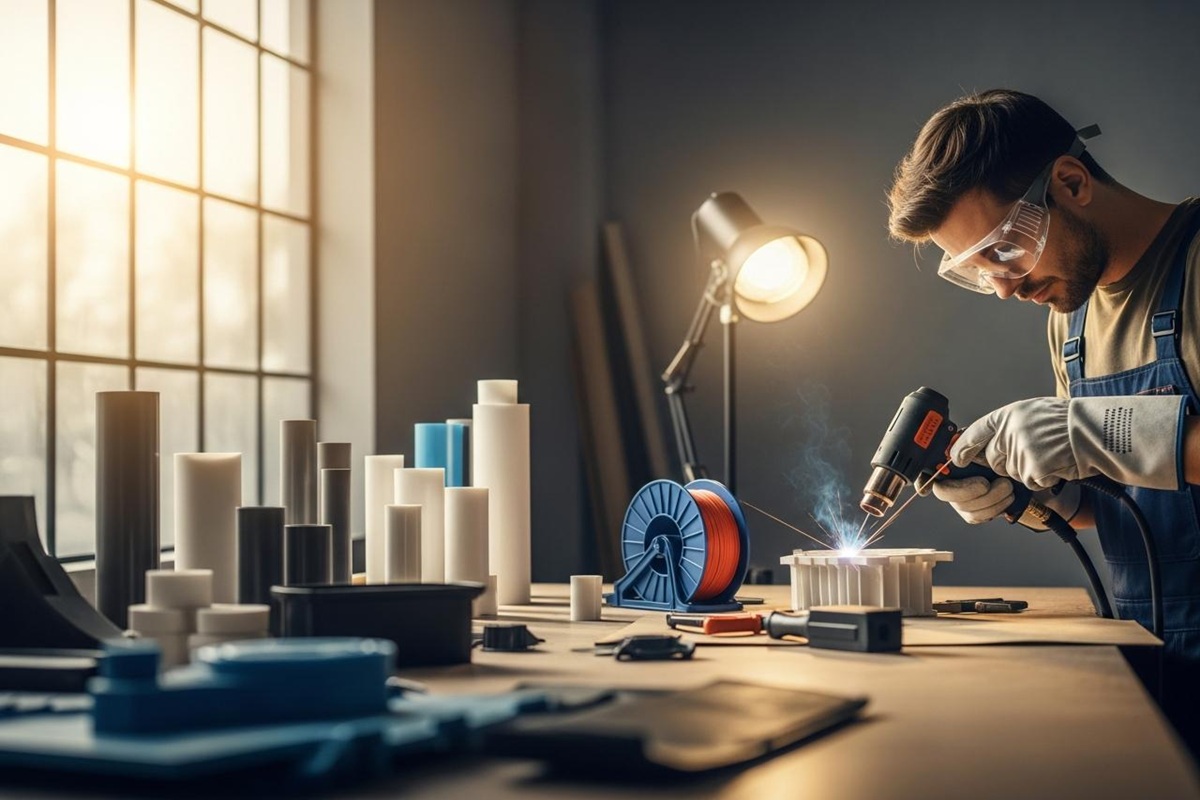
Hot gas welding is a flexible technique, similar to TIG welding, using a specialized hot air gun. I heat the parent material and filler rod simultaneously, applying pressure to fuse them as they cool.
- Common Applications: Repairing chemical tanks, custom ducting, and joining sheets or pipes.
- Best for: On-site repairs and one-off projects using HDPE, Polypropylene, and PVC.
- Key Advantage: Versatility and portability make it invaluable for large structures and field work.
Friction Welding: Speed and Strength
Friction welding uses mechanical friction to generate heat, creating a fast, clean, and strong weld. Through spin or vibration techniques, parts are fused under pressure without extra filler or solvents.
- Common Applications: High-volume automotive parts, consumer goods, and sealed industrial components.
- Best for: Joining complex, small-to-medium parts requiring speed and hermetic seals.
- Key Advantage: Produces repeatable, strong welds with minimal flash, ideal for automation.
Laser Plastic Welding: The Precision Specialist
Laser plastic welding offers unmatched precision for clean, aesthetically perfect bonds without vibration or particles. The laser passes through a transparent layer to heat an absorbent layer, fusing them seamlessly at the interface.
- Common Applications: Medical devices, electronic enclosures, sensors, and microfluidic components.
- Best for: Delicate, high-value parts where cleanliness and precision are non-negotiable.
- Key Advantage: Exceptional control, producing cosmetically perfect and particle-free results.
Heat Welding vs. Solvent Welding: A Key Fabrication Choice
Choosing between heat-based methods and solvent welding depends entirely on the material and application requirements. Thermal energy fuses polymer chains, while chemical solvents temporarily dissolve surfaces to create a bond.
- Heat Welding: Best for structural bonds in polyolefins like HDPE and Polypropylene.
- Solvent Welding: Ideal for amorphous plastics like PVC and ABS in plumbing.
- Key Advantage: Heat welding handles structural loads; solvent welding provides fast, leak-proof seals.
Choosing the Right Fabrication Technique for Your Project
Selecting the correct welding method is fundamental to ensuring the long-term integrity of your final product. Evaluating these specific factors will guide you toward the most effective and economical fabrication solution.
- Material Type: Identifying the specific polymer (PVC, HDPE, ABS) is the most critical first step.
- Geometry & Volume: Consider part complexity and whether you need a one-off repair or mass production.
- Weld Requirements: Determine if the project demands structural strength, hermetic seals, or a cosmetic finish.
Get Expert Advice for Your Next Project
Choosing the right welding method is essential for the durability and success of your application. Our team at Plastek provides the specialized expertise and precision needed for high-quality plastic fabrication across South Africa.
Whether you need a one-off structural repair or a high-volume production run, we have the technology and experience to deliver perfect results. Contact Plastek today to discuss your project requirements and let us help you find the most effective fabrication solution.
FAQs
Can all plastics be welded?
No, only thermoplastics can be welded. These plastics can be softened by heat and re-hardened on cooling. Thermoset plastics, which undergo an irreversible chemical change when heated, cannot be re-melted or welded.
What is the strongest plastic weld?
Friction welding (spin and vibration) and laser welding typically produce the strongest bonds, often reaching 90-100% of the strength of the parent material. The strength of any weld, however, depends heavily on proper procedure and material compatibility.
How do you prepare plastic for welding?
Proper preparation is vital. The surfaces must be clean, dry, and free of any oils, dirt, or oxidation. For some plastics, this may involve wiping with a suitable solvent like isopropyl alcohol or lightly abrading the surface to ensure a good bond.
Is plastic welding waterproof?
Yes, when performed correctly, a plastic weld creates a seamless, homogenous bond that is completely waterproof and often airtight (hermetically sealed). This is why it is a preferred method for fabricating tanks, pipes, and sealed enclosures.
What equipment is needed for hot gas welding?
The basic equipment for hot gas welding includes a specialised hot air welder (gun) with temperature controls, a selection of nozzles to direct the airflow, and a plastic filler rod made of the same material as the parts being joined.
