

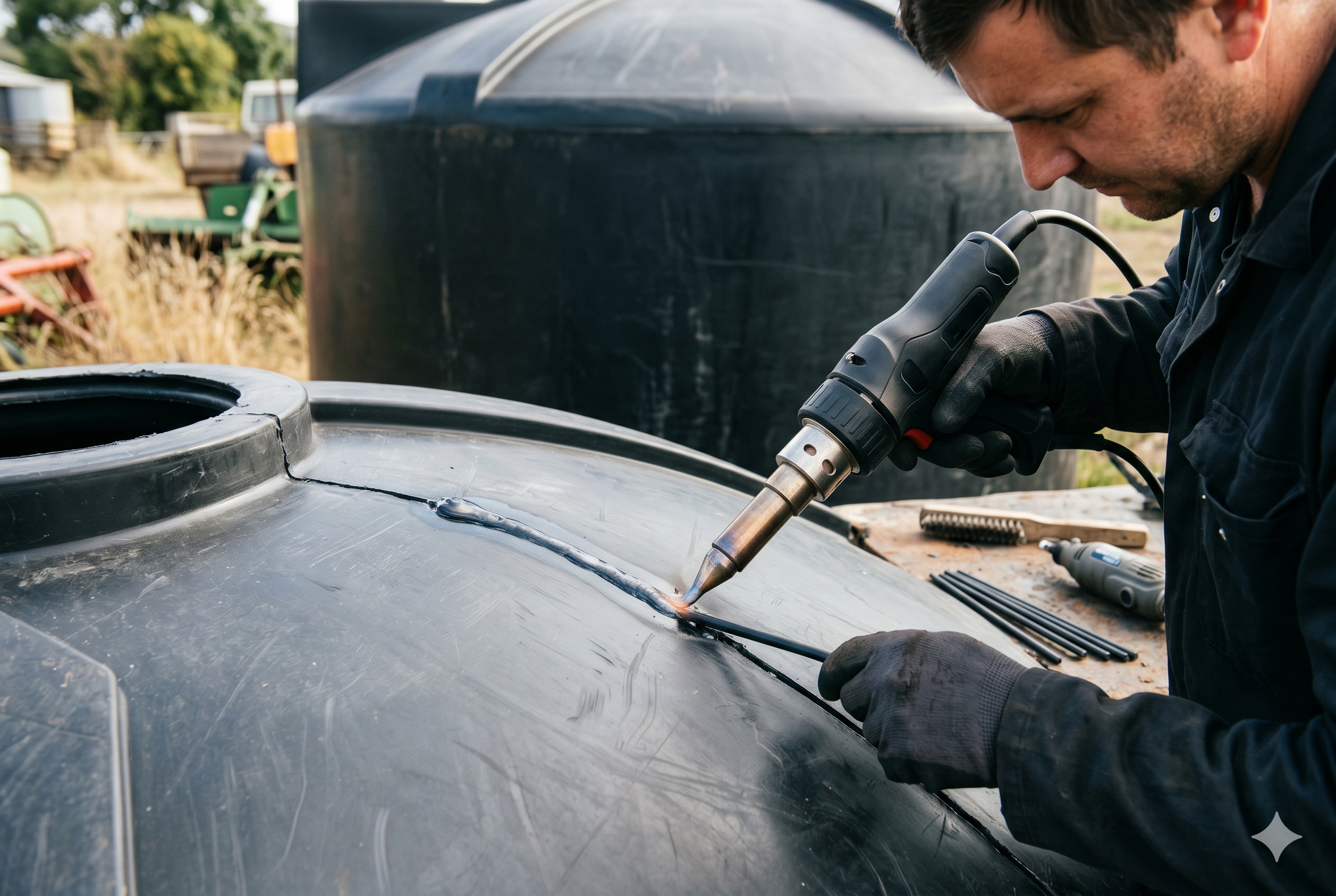
The best plastic welding gun for tank repairs is one that matches the tank’s material properties and the repair environment. For most polyethylene (HDPE, LDPE) water and agricultural tanks in South Africa, a 200-watt airless welder with a quality ceramic heating element offers the best balance of power and control.
This wattage provides sufficient heat to melt the base material and welding rod, ensuring a strong, molecular bond. The Poly Welder Pro and Polyvance Mini-Weld Model 7 are effective tools for these applications.
Top-Rated Plastic Welding Guns for Water and Agricultural Tanks
Choosing the right plastic welding gun for water and agricultural tanks is essential for ensuring repairs can withstand mechanical stress and thermal fluctuations.
- Best Overall: Poly Welder Pro Plastic Repair Kit: This 200W airless welder features a heavy-duty ceramic heating element for consistent heat delivery. It is particularly effective for agricultural tanks because it includes stainless steel reinforcing mesh to provide structural integrity across large cracks.
- Best Professional Grade: Wegener Airtherm 1600W: A high-output, 1600W hot air welder designed for continuous use, this German-engineered tool offers stepless temperature control. Its rear air intake design helps protect the motor from dust and debris during on-site field repairs.
- Best for Beginners: Polyvance Mini-Weld Model 7 Airless Welder: This 200W system simplifies the process by using a control dial labeled with plastic types rather than numerical temperatures. It includes eight varieties of welding rods, making it a versatile choice for users unfamiliar with different polymer blends.
- Best Industrial Solution: Norwesco Poly Tank Repair Gun: Produced by a leading tank manufacturer, this gun uses a specialized welding wire containing integrated copolymers and adhesives. It is the most reliable option for owners of Norwesco tanks as it is specifically calibrated for their proprietary polyethylene grades.
By matching the welder’s capabilities to the specific material and damage type, you can ensure a durable, leak-proof bond that extends the life of your storage equipment.
Material Compatibility: HDPE, LDPE, and Polypropylene
The success of a plastic weld depends entirely on molecular compatibility, requiring the use of a welding rod made from the same polymer as the tank itself. High-Density Polyethylene (HDPE) and Low-Density Polyethylene (LDPE) are the most prevalent materials for water and agricultural tanks in South Africa because of their superior chemical resistance and durability.
Most specialized repair kits, such as the Poly Welder Pro and Norwesco systems, are specifically engineered to bond with these polyethylene grades. In contrast, Polypropylene (PP) is typically reserved for chemical storage and automotive parts and demands its own specific welding rod; for these applications, the Polyvance Mini-Weld Model 7 is an ideal choice as it includes dedicated PP rods in its kit.
Key Factors to Consider When Choosing a Tank Welder
The performance of a plastic weld is dictated by the correct application of heat and the compatibility of materials, requiring a technical assessment of several key factors. Choosing the right tool ensures that the repair maintains the structural integrity required for industrial and agricultural applications.
- Mechanism and Application Control: The primary choice lies between airless welders, which use a heated metal tip for focused energy on detailed crack repairs, and hot air welders that soften the material and rod simultaneously for larger seams. For most on-site tank work, airless systems are preferred because they offer greater control, prevent surface distortion, and do not require the use of an external air compressor.
- Technical Specifications and Field Usability: Successful outcomes depend on precise temperature management, ranging from stepless professional adjustments to simplified material-specific dials that prevent polymer degradation. While a 200W element is typically sufficient for standard repairs, the choice of equipment must also account for portability and ergonomic design to ensure the tool can be effectively manipulated in the confined or awkward positions often encountered during field repairs.
Balancing these heating mechanisms with the specific wattage and portability needs of the environment; you can select a welder that ensures a durable, professional-grade bond.
Common Mistakes to Avoid During Plastic Tank Welding
Achieving a durable repair requires precise technique, as even the highest-quality tools cannot compensate for fundamental errors. Overheating the plastic is a frequent mistake that leads to brittle, weakened structures marked by discoloration and smoke, while insufficient heat results in a “cold weld” where the rod and base material fail to fuse properly.
Furthermore, using a welding rod that does not match the tank’s polymer prevents bonding at a molecular level, causing the repair to fail under stress. Finally, neglecting thorough surface preparation is a critical oversight, as any dirt, grease, or moisture remaining in the repair area will act as a barrier and prevent a secure bond from forming.
Step-by-Step: How to Use a Plastic Welding Gun for Tank Leaks
Properly repairing a leak requires a methodical approach to ensure the new material integrates fully with the existing tank structure. Following a structured welding process will help you achieve a high-strength, leak-proof seal that stands up to industrial or agricultural use.
- Preparation is key. Clean the area around the crack thoroughly, removing all dirt and contaminants.
- Create a V-groove. Use a rotary tool to grind a “V” shape along the crack, about halfway through the tank wall. This increases the surface area for the weld.
- Pre-heat the surface. Gently heat the area around the groove with your welder until the plastic becomes tacky to the touch.
- Lay the first pass. Begin feeding the welding rod into the V-groove, applying heat to both the rod and the base material until they melt and fuse.
- Build up the weld. Apply subsequent layers of welding rod until the groove is filled, and the repair is slightly proud of the tank’s surface.
- Smooth the surface. While the plastic is still hot, use the welder tip to smooth the final weld, ensuring a seamless bond with the tank wall.
Once the area has cooled completely, the molecular bond will be fully established, restoring the tank’s integrity and preventing further leakage. Taking these steps carefully ensures a professional finish that extends the operational life of your storage equipment.
Essential Accessories for Successful Tank Repair
Achieving a high-quality tank repair often requires a suite of critical support accessories beyond the welding gun itself. To ensure a successful bond, a rotary tool equipped with a V-groove bit is essential for properly preparing the cracks, while a wire brush should be used to clean the welder tip between applications to prevent material contamination.
For repairs involving large cracks or holes, embedding stainless steel reinforcing mesh into the plastic provides vital structural strength like reinforcement in construction. Finally, it is crucial to maintain a consistent stock of welding rods that specifically match the polymer material of the tanks being serviced to ensure molecular compatibility.
Get a Technical Assessment
Your tank’s integrity depends on a professional repair. Our technicians can identify the specific polymer of your tank and apply the correct welding procedure to ensure a permanent, leak-proof seal. We use industrial-grade equipment to restore structural integrity. Request a quote by clicking the button below.
FAQs
Can you weld a plastic water tank while it has water in it?
No. The tank must be completely empty and dry. The presence of water will prevent the plastic from reaching the necessary welding temperature and will introduce contaminants into the repair area, guaranteeing a failed weld.
What is the best way to stop a crack in a plastic tank from spreading?
The most effective method is to drill a small hole at the very end of the crack. This technique, known as “stop-drilling,” distributes the stress at the tip of the crack over a wider area, preventing it from propagating further. The hole and the crack should then be prepared and welded.
Do I need a hot air or an airless welder for high-density polyethylene (HDPE)?
For most HDPE tank repairs, an airless welder is sufficient and easier to control, especially for beginners. A hot air welder can be faster for very thick materials or long seams but requires a higher level of skill to avoid warping the tank.
Is plastic welding stronger than using epoxy for tank leaks?
Yes. A proper plastic weld creates a molecular bond by fusing the parent material with the welding rod, restoring the original integrity of the plastic. Epoxies and other adhesives only provide a surface-level bond, which is prone to failure over time due to flex, pressure, and UV exposure, especially with polyethylene, which has a non-stick surface.
