

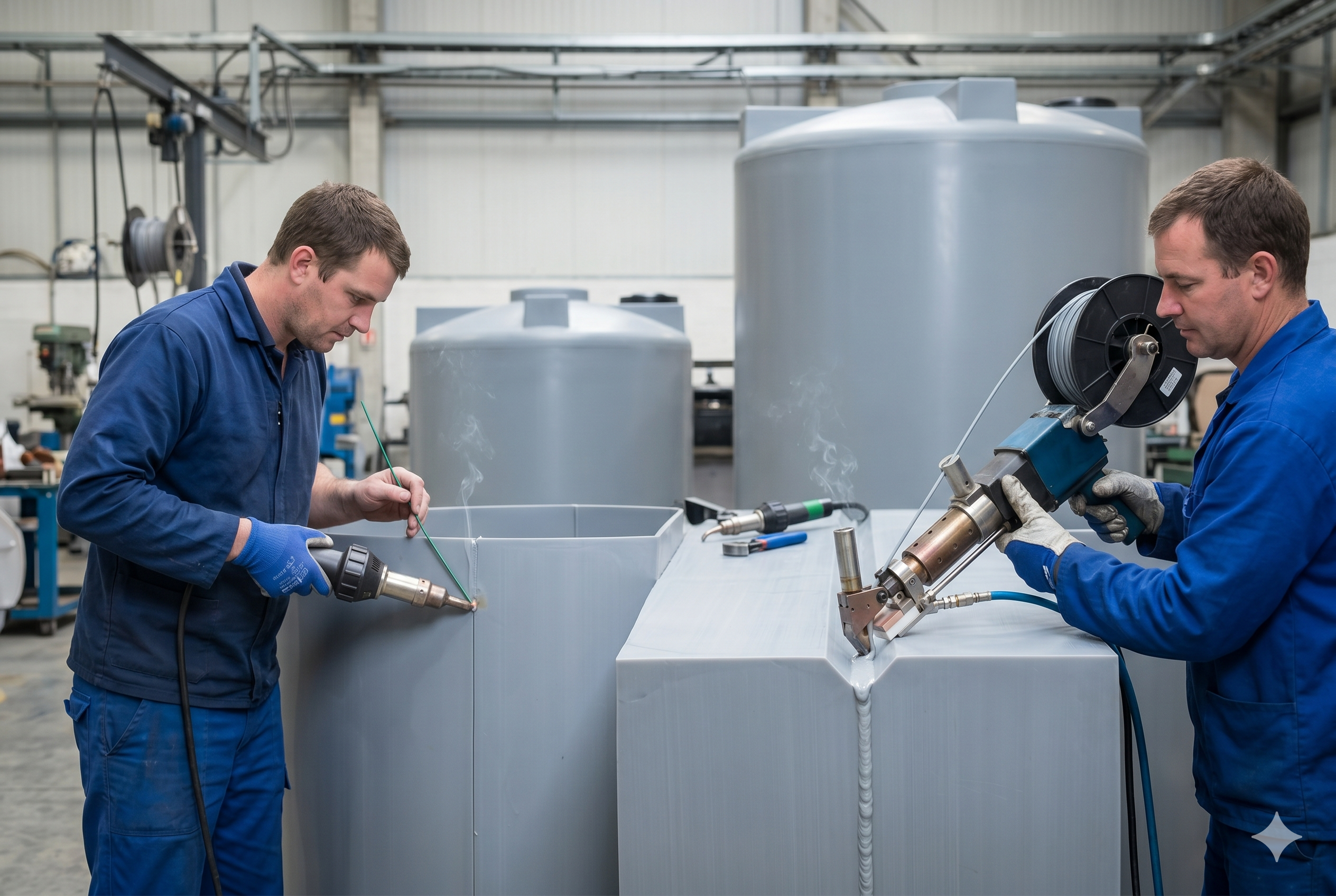
The primary difference is that hot air welding is for thin materials, while extrusion welding is for thick sections. A hot air welder uses heated gas to soften the parent material and a separate filler rod, creating a bond suitable for materials typically up to 5mm.
Extrusion welding, however, forces a molten plastic to extrudate directly into a prepared seam on a preheated surface, creating a larger, more homogeneous weld in a single pass for materials thicker than 6mm. This makes extrusion the superior method for structural applications where integrity is non-negotiable.
Understanding Hot Air Plastic Welding: Process and Mechanics
Hot air welding is a manual process that joins thermoplastic sheets using three key variables: temperature, pressure, and time. The technician directs hot air to soften both the plastic substrate, and a compatible filler rod to their glass transition temperature, then applies pressure to fuse them together through intermolecular diffusion. A strong molecular bond forms only when the rod and base material are identical, with weld quality depending entirely on the technician’s consistent control of heat and pressure.
Understanding Extrusion Plastic Welding: How It Works
Extrusion welding automates the process and reduces operator variability. The welder feeds a thermoplastic rod into a heated barrel, melts it, and extrudes the molten material through a PTFE shoe directly into the weld joint, while a separate hot air nozzle preheats the parent material for optimal fusion.
This integrated technique applies consistent pressure through the tool’s forward movement, producing a large, uniform weld bead in a single pass that delivers stronger structural integrity and lower thermal stress.
Speed and Efficiency: Which Method is Faster?
Extrusion welding offers superior speed and efficiency compared to hot air welding, especially on larger projects and thicker materials.
- Welding Speed: Extrusion welding can be up to five times faster than hot air welding for materials over 6mm thick, as it deposits a large volume of filler material in a single pass, significantly reducing labour time and helping meet tight project deadlines.
- Load-Shedding Challenges: In South Africa, sudden power cuts can solidify molten plastic in the extruder, cause equipment damage from surges, and prevent machines from reaching proper temperature. Using a voltage stabiliser is essential for reliable operation.
Overall, extrusion welding is the faster and more productive choice for industrial-scale work, provided power stability is properly managed.
Material Compatibility: HDPE, PP, and PVC Considerations
Both hot air and extrusion welding work with common thermoplastics, but material properties significantly influence the choice of method. HDPE and PP are the most versatile and widely used, offering broad processing windows suitable for both techniques.
PVC is more challenging due to its narrow temperature range, which makes it prone to degradation if not handled carefully. Ultimately, hot air welding is ideal for thinner, flexible materials and detailed repair work, while extrusion welding is the preferred choice for thick sections (over 6mm) and large-scale fabrications where strength and speed are critical.
Pros and Cons of Handheld Hot Air Tools
Handheld hot air welders are a popular choice for many plastic fabrication and repair applications due to their portability and versatility.
- Advantages: They are lightweight, portable, and ideal for on-site repairs and hard-to-reach areas. They also have a lower initial cost and are excellent for tacking and detailed work.
- Disadvantages: Weld quality is highly dependent on operator skill; they are not suitable for materials thicker than 6mm, and the process is slower as it often requires multiple passes, increasing the risk of defects.
Overall, handheld hot air tools are best suited for thinner materials and intricate repair work rather than large structural projects.
Pros and Cons of Industrial Extrusion Welders
Industrial extrusion welders offer a powerful solution for high-volume plastic fabrication, balancing extreme durability against specialized operational needs.
- Pros: They deliver unmatched structural integrity by creating deep, homogeneous bonds and offer high deposition rates that significantly accelerate large-scale production.
- Cons: The equipment involves a higher capital investment and demands specialized operator expertise to manage its weight and limited maneuverability in confined spaces.
These tools remain the industry standard for heavy-duty geomembrane and tank construction where weld strength is non-negotiable.
Find the Right Welder
From lightweight, precision hot air torches for detailed repairs to heavy-duty, high-output extrusion welders for thick-walled tanks, having the right tool changes everything. Managing operational variables; especially under erratic local power conditions; requires the right setup from day one.
Tell us about your material specs and project scope, and we will help you select or configure the ideal welding equipment for the job. Request a quote for custom equipment by clicking the button below.
FAQs
Which method produces a stronger weld for heavy-duty tanks?
Extrusion welding produces a far stronger, more reliable, and homogeneous weld essential for heavy-duty applications like chemical and water storage tanks. The single-pass application of a large volume of extrudate ensures a continuous, void-free bond capable of handling high mechanical loads.
Can I use a hot air welder for materials thicker than 10mm?
No, this is not recommended. While technically possible with multiple passes, the risk of creating a weak joint with internal defects or insufficient bonding is extremely high. For materials over 6mm, extrusion welding is the correct industrial method to ensure a structural, homogeneous bond.
Does extrusion welding require a separate air supply?
Not always. Many modern handheld extrusion welders have an integrated, brushless blower to provide hot air for preheating the substrate. However, some larger or older models may require a separate, clean, and dry compressed air source.
What is the learning curve difference between hot air and extrusion welding?
Hot air welding is generally simpler to learn for basic repairs, but achieving consistent, high-quality structural welds requires significant skill and practice. Extrusion welding requires more intensive initial training to understand the machine’s parameters, temperature controls, and welding shoe setup, but the process itself provides more consistency once mastered.
