

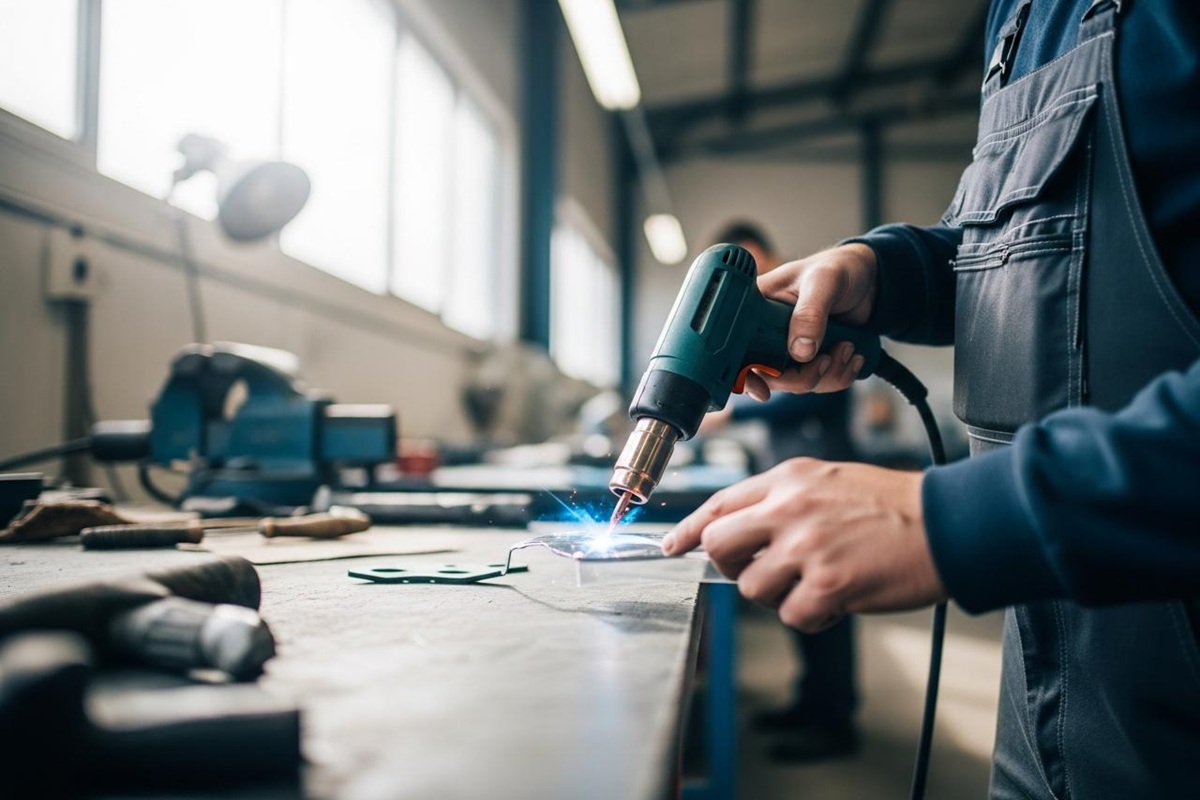
There isn’t one simple name for a plastic welder; the term depends entirely on the technology, material, and application. It is like “wood joining,” where the tool could be anything from a hammer to a complex jig.
In plastic fabrication, precision starts using the correct terminology. This guide covers technical naming conventions to help you speak like a professional and source the exact equipment you need.
It’s Not One Tool, It’s a Family of Fabrication Tools
A “plastic welder” is a broad category rather than a specific device, with tools designed for heat, vibration, or solvent bonding. Each name is typically derived from the specific process the tool performs.
Understanding these distinctions is fundamental for achieving a durable, seamless weld. Choosing the wrong tool often leads to weak points, material damage, and total project failure.
The Most Common Types of Plastic Welders Explained
Let’s break down the primary types of plastic welders you will encounter in South Africa, from workshop staples to industrial machinery.
The Hot Air Gun (or Hot Gas Welder)
The hot air gun, or hot gas welder, uses a precise jet of heated air or nitrogen to melt plastic surfaces and a filler rod simultaneously. This creates a fused, single piece once the material cools.
- Best for: On-site repairs, joining sheets, and welding pipes or tanks.
- Common Materials: Polypropylene (PP), Polyethylene (HDPE, LDPE), and PVC.
The Plastic Extrusion Welder
The plastic extrusion welder is a heavy-duty tool that pre-heats joints while simultaneously extruding a thick bead of molten rod into the weld zone. This process allows for high-volume material deposition and creates exceptionally strong bonds.
- Best for: Large-scale fabrication, landfill liners, and joining sections over 6mm thick.
- Common Materials: HDPE and PP.
The Ultrasonic Welder
The ultrasonic welder uses high-frequency acoustic vibrations (20-40 kHz) to create localized friction and heat between plastic parts. Components are held under pressure to form an instant solid-state weld without any filler rods or external heat.
- Best for: High-volume, automated production, and delicate components.
- Common Materials: ABS, Polystyrene, and Polycarbonate.
How to Choose the Right Plastic Welder for Your Project
Selecting the correct tool comes down to three main factors. Before you invest, you must have clear answers to the following:
- What type of plastic are you working with? Different thermoplastics have different melting points and properties, dictating the best welding method.
- What is the application and scale? Repairing a crack in a water tank requires a different tool than assembling thousands of electronic casings.
- How strong does the weld need to be? Extrusion welding, for instance, typically creates a stronger bond on thick sheets than hot air welding alone.
Partner with the Experts at Plastek
Navigating the world of fabrication tools and technical naming conventions can be complex. Getting it right saves time, money, and ensures the structural integrity of your work. At Plastek, we’ve guided countless professionals and businesses in South Africa toward the ideal plastic welding solutions for their specific projects. If you need advice on selecting the right equipment or materials, our team is here to provide expert guidance.
FAQs
Can you use a soldering iron for plastic welding?
While technically possible for very small, non-structural repairs, it is not recommended. A soldering iron provides inconsistent heat and lacks the airflow to properly heat the parent material, often resulting in a weak, superficial bond that is more of a “melted patch” than a true weld.
What is the strongest type of plastic weld?
The strength of a weld depends on the technique, material compatibility, and the process itself. For thick materials like HDPE, extrusion welding is generally considered one of the strongest methods as it deposits a large amount of filler material and achieves excellent fusion.
Can all plastics be welded?
No. Only thermoplastics can be welded. These are plastics that can be melted and reformed without chemical degradation, like PE, PP, PVC, and ABS. Thermoset plastics (like epoxy or polyurethane) undergo an irreversible chemical change when cured and will burn, not melt, if heat is applied.
Is plastic welding difficult to learn?
Basic hot air welding can be learned with practice. However, achieving consistently strong and clean welds, especially with extrusion or ultrasonic methods, requires proper training and skill. Understanding temperature control, travel speed, and pressure is essential for a professional result.
What is a plastic welding rod used for?
A plastic welding rod is a filler material used in hot air and extrusion welding. It is made from the same type of plastic as the parent materials being joined. When melted into the prepared seam, it ensures a strong, homogenous bond as the three parts (two parent pieces and the rod) fuse into one.
