

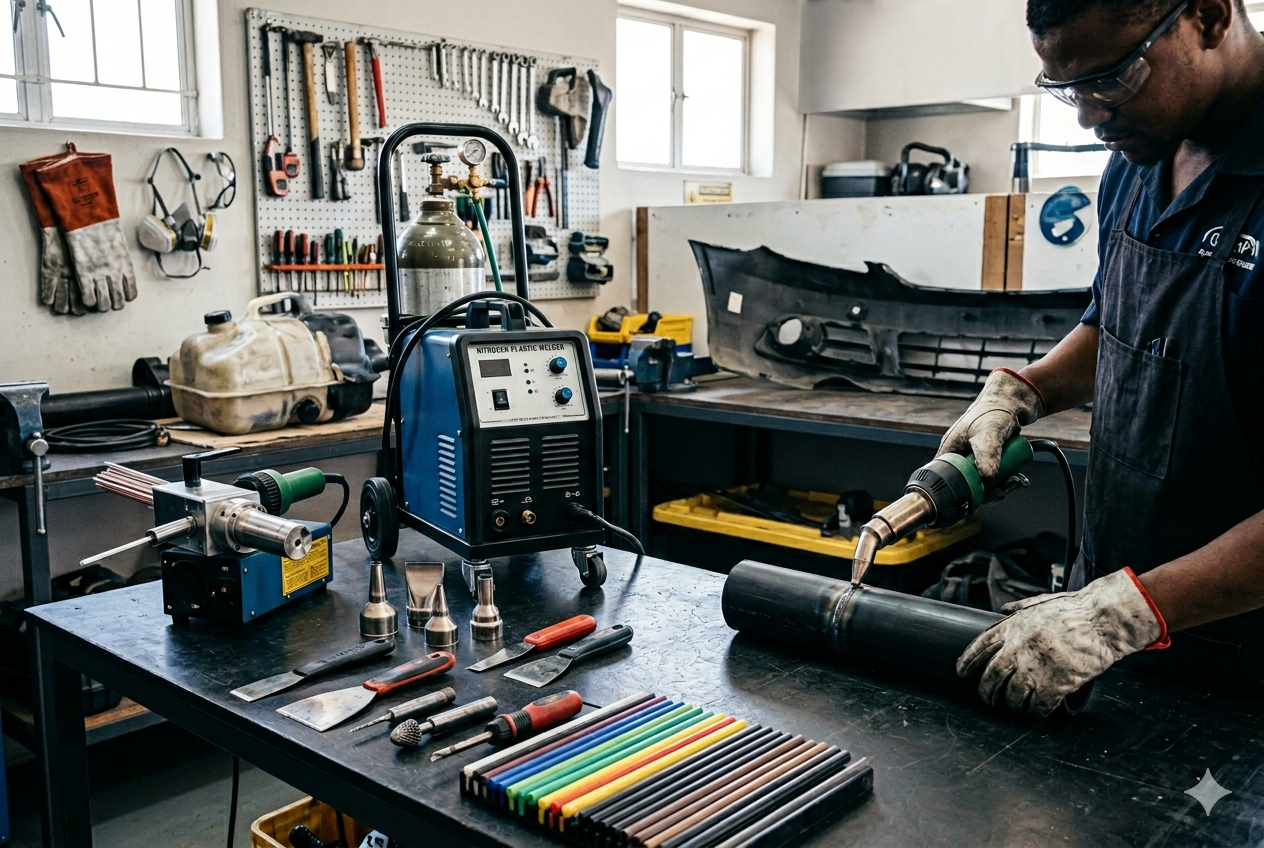
Starting a plastic welding business requires a specific inventory of core equipment, specialised accessories, and the correct consumables. Your primary investment will be a professional-grade welder, with the choice depending on your target application, such as a hot air welder for general fabrication or a nitrogen welder for automotive work.
This is supplemented by essential hand tools for surface preparation, reinforcement materials like staples and mesh, and a range of plastic welding rods matched to the materials you will repair. Finally, a non-negotiable inventory of safety equipment is mandatory to ensure a safe workspace.
The Core Essentials: Choosing Your First Plastic Welder
Matching the specific welding technology to your intended material and project scale, you can ensure consistent results across various industrial and automotive applications.
- Hot Air Hand Welders: These versatile industry standards are the primary workhorses for new fabrication businesses, using a stream of heated air to fuse materials like PVC, PP, and PE.
- Extrusion Welders: Designed for heavy-duty applications, these machines heat and plasticize a welding rod before extruding it as a molten bead.
- Nitrogen Plastic Welders: Crucial for high-end automotive repair; these systems use nitrogen as a shielding gas to displace oxygen during the welding process. This prevents the rapid oxidation that causes brittle welds.
Investing in the correct welding system allows you to expand your service offering from general maintenance to specialized and high-specification repairs.
Essential Accessories and Finishing Tools
Professional grade plastic welding requires a suite of specialized nozzles to direct heated air, pre-heat substrates, and efficiently feed welding rods into seams. Achieving a true molecular bond is impossible without surface preparation tools like rotary burrs and hand scrapers to thoroughly clean the plastic.
For high stress structural repairs, mechanical reinforcement tools like hot staplers and stainless-steel mesh provide a rigid internal framework to prevent future cracking. The final integrity and aesthetics of the weld are maintained by utilizing specialized cutters and cleaning brushes to keep the workspace immaculate. Integrating these specialized components into your workflow allows you to transition from basic patching to durable and high-specification fabrication.
Safety Equipment and Workspace Requirements
Maintaining a safe operating environment is mandatory when working with plastic welding equipment due to the extreme temperatures and potential chemical hazards involved.
- Thermal and Skin Protection: Heat-resistant gloves are essential to protect hands from the high temperatures generated by the welder, while wearing long sleeves and trousers provides a vital barrier against accidental contact with hot tools or molten plastic.
- Respiratory and Ocular Safety: Protective eyewear shields the eyes from stray hot plastic particles, and a respirator or specialized face mask must be used to prevent the inhalation of hazardous fumes released during the melting of certain polymers.
Strictly adhering to these PPE requirements and ensuring constant airflow, you can mitigate the primary risks of burns and respiratory irritation.
Scalability and Future-Proofing Your Workshop
Building a plastic welding business starts with a solid foundation of the correct core equipment matched to your target market. A high-quality hot air welder provides the versatility for a broad range of general repairs, while specialising in sectors like automotive or heavy fabrication necessitates investment in specific technologies like nitrogen or extrusion welders.
The key to long-term success lies in mastering the technical process, from meticulous surface preparation to correct material matching. As your business grows, you can scale your capabilities by investing in more advanced machinery and pursuing further certifications, solidifying your reputation as a technical expert in the field.
Ready to Build Your Workshop? Select Your Equipment
Your equipment is the backbone of your business, and choosing the right setup early on prevents costly upgrades and performance issues later. Whether you are focusing on automotive repairs, heavy fabrication, or general maintenance, we help you identify the exact tools required to meet your service standards.
Don’t leave your initial investment to guesswork. Reach out to our technical team today for a tailored equipment audit and a quote on a professional-grade package built for your specific business goals. Click the button below to get started.
FAQs
What is the best plastic welder for a beginner?
For a beginner, a versatile and user-friendly option is a quality hot air hand welder, such as a Leister Triac ST or a similar model with adjustable temperature controls. This allows you to work on a wide variety of common thermoplastics like PP and HDPE by matching the heat to the material’s specific melting point. It is a foundational tool for general repairs and fabrication.
Do I need a certification to start a plastic welding business?
While there isn’t a mandatory legal certification required to operate a plastic welding business in South Africa, obtaining one is highly recommended to establish professional credibility.
Can you weld different types of plastic together?
No, you cannot successfully weld different types of plastic together. Successful thermoplastic welding relies on fusing “like” materials, for example, polypropylene (PP) to polypropylene (PP).
