

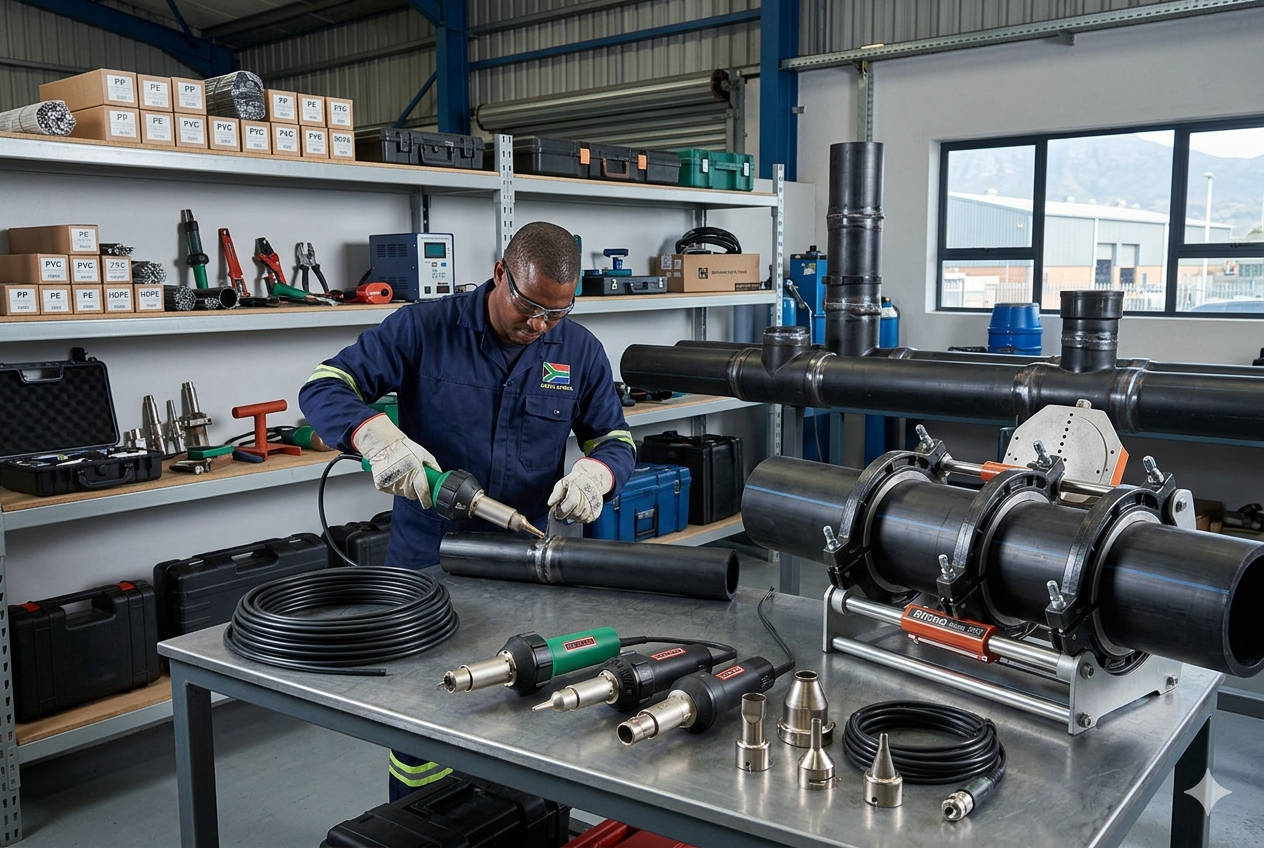
You can buy plastic welding equipment from specialised industrial suppliers, with concentrations in Johannesburg, Cape Town, and Durban. These distributors provide access to professional European brands like Leister, Ritmo, and Weldy, which are essential for structural integrity in fabrication and repairs.
Sourcing the correct apparatus depends on the polymer’s technical specifications and the application, from handheld hot air tools to large-scale butt fusion machines. For DIY applications, general tool suppliers offer basic kits for non-structural cosmetic repairs.
Locating a Technical Supplier
Selecting a technical supplier is a critical decision that ensures your equipment is correctly specified to achieve permanent molecular bonds in high-stakes applications.
- Brand Specialization: Leading distributors like Plasti-Weld provide access to top-tier brands, including Leister for industrial process heat, Ritmo for pipe fusion, and Weldy for versatile hot air tools.
- Maintenance and Calibration: Reputable suppliers maintain dedicated workshop facilities to perform essential equipment repairs and precision calibrations.
- Technical Consultation: A competent supplier offers material-specific advice on heat and pressure parameters to prevent weld failure in critical infrastructure.
- OEM Support: National suppliers ensure the long-term serviceability of your tools by stocking genuine manufacturer spare parts and specialized accessories.
Partnering with a supplier that offers robust technical support and a verifiable track record, you safeguard your operational efficiency and ensure compliance with rigorous industry standards.
Industrial vs. DIY Welding Tools
Industrial welders utilize closed-loop control systems and digital microprocessors to maintain the precise temperatures necessary for achieving full-strength molecular fusion. Conversely, DIY-grade tools from general suppliers feature less accurate analogue controls and are intended primarily for simple, non-structural repairs where weld failure has low consequences.
Professional equipment is engineered for continuous production environments, whereas consumer models are limited to intermittent use and lack advanced airflow precision. This ability to regulate air volume is essential because temperature deviations of just a few degrees can easily compromise material thickness and cause joints to fail under mechanical stress.
Essential Accessories and Professional Training
Achieving a high-specification plastic weld requires a combination of identical consumable materials, specialized nozzles, and accredited technical training.
- Material Compatibility and Tooling: Effective molecular fusion requires a welding rod made from the exact same polymer as the substrate, paired with specialized nozzles that shape the hot air flow for optimal heat transfer and cross-linking.
- Accredited South African Training: Organizations like Plastics SA provide formal training services that cover critical polymer properties, which is highly vital for structural applications and technical competency.
- Industrial Piping Standards: For high-pressure water and mining systems, organizations like SAPPMA ensure compliance with SANS quality standards using specialized butt fusion or electrofusion equipment from local suppliers to create leak-proof joints.
Combining precision hardware with certified operator expertise, you ensure that every completed plastic fabrication can withstand long-term environmental and mechanical stress.
Next Steps
To select the correct welding equipment, a technical analysis of your specific plastic material and application is required. We can evaluate your requirements and ensure the machine you invest in is capable of producing welds that meet the necessary structural and performance standards. Get in touch with us by clicking the button below to request a formal quote.
FAQs
Can I use a standard soldering iron for plastic welding?
No. A soldering iron is designed for melting metallic solder and cannot produce the controlled, high-volume hot air stream needed to properly heat and fuse thermoplastic materials.
What is the best plastic welder for repairing car bumpers in South Africa?
For automotive bumper repairs, which typically involve PP or TPO plastics, a professional hot air hand tool like the Weldy energy HT1600 or a Leister equivalent is recommended. These tools allow for precise temperature control, which is essential for achieving a strong, durable repair rather than a purely cosmetic one.
Where can I find accredited plastic welding training courses in South Africa?
Plastics SA is the primary provider of accredited training for the plastics industry in South Africa, offering courses in Gauteng, the Western Cape, and KwaZulu-Natal. Their programmes cover various plastic processing techniques, including welding, and are recognised for upholding industry standards.
