

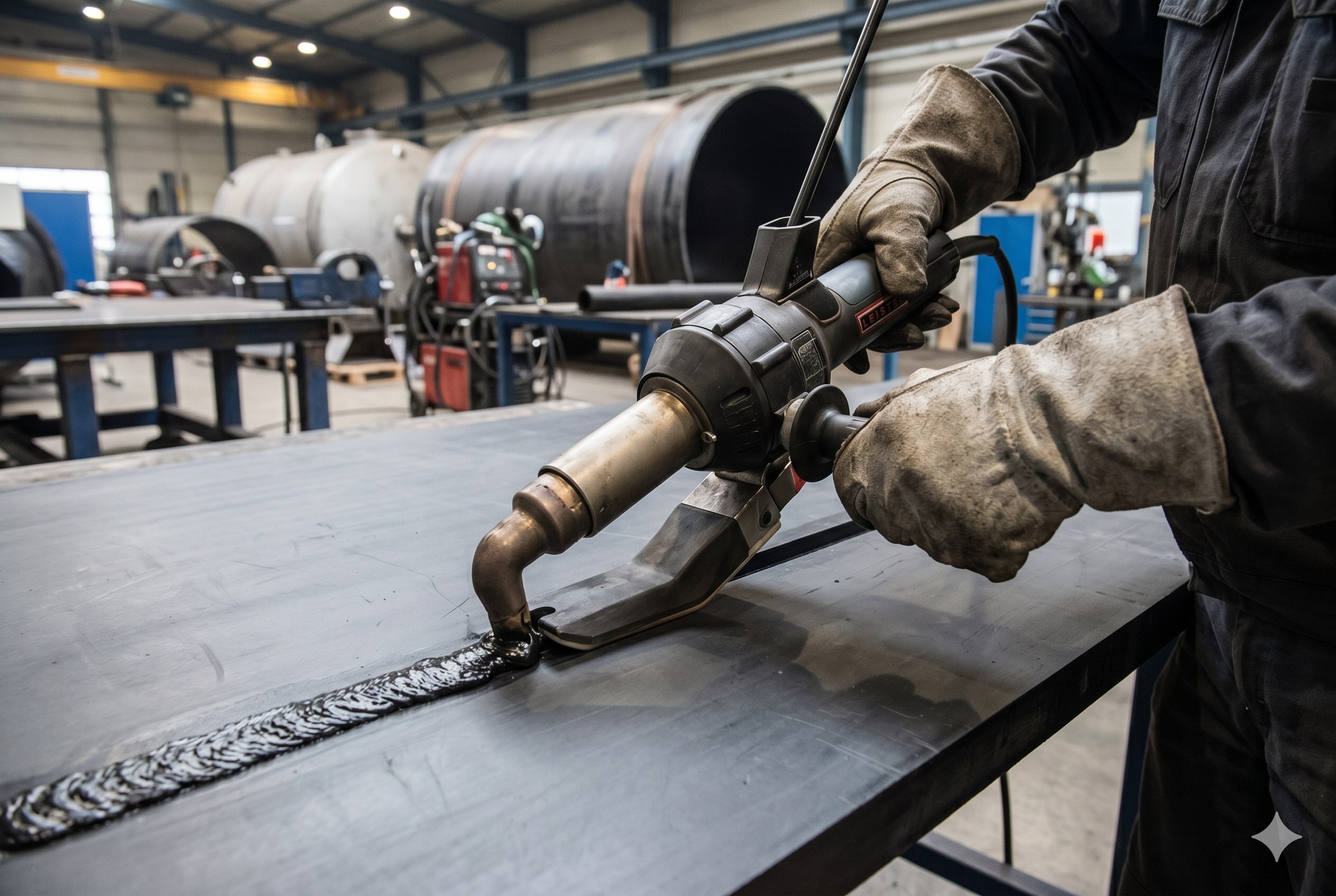
The best extrusion welder for large plastic fabrication is the Leister WELDPLAST 600, delivering the highest output at up to 6.0 kg/h for thick-walled HDPE and PP projects. For specialised geomembrane and rigid sheet applications, the Demtech Pro-X provides a robust combination of power and reliability.
The selection hinges on the required material output, the specific thermoplastic being used, and compliance with German welding standards (DVS). The bottom line is that matching the machine’s mechanics to the project’s physical demands is non-negotiable for structural integrity.
Why Extrusion Welding is Essential for Large-Scale Fabrication
Extrusion welding is the industry standard for joining thermoplastics thicker than 6mm, utilizing a molten extrudate to create high-strength, homogenous bonds in a single pass. By combining a heated internal screw with a hot air pre-heating system, the process ensures deep molecular fusion essential for heavy-duty applications like chemical tanks and landfill liners.
Adhering to DVS 2207-4 standards further guarantees structural integrity by regulating temperature, pressure, and preparation, resulting in a reliable joint that matches the strength of the parent material.
Key Features to Look for in a Heavy-Duty Extrusion Welder
Selecting an industrial-grade extruder requires a rigorous technical assessment of its core systems to ensure it can withstand the demanding conditions of South African mining and chemical environments. The machine must be engineered for sustained performance, prioritizing precise thermal control and mechanical reliability to achieve structural fusion.
- Extrusion Output and Volumetric Capacity: Output measured in kg/h determines project efficiency, and high-capacity units are essential for maintaining fusion depth on sheets exceeding 20mm.
- Closed-Loop Digital Temperature Control: Advanced sensors provide real-time feedback to maintain precise temperature windows and prevent material degradation or cold join weak spots.
- Integrated Protective Systems: Safety features including separate air controls and cold start motor protection ensure equipment operates within safe parameters to protect the internal screw.
- Ergonomics and Operational Balance: Strategic weight distribution and multiple grip positions reduce operator fatigue and ensure the consistent travel speed vital for maintaining weld integrity.
Prioritizing these specialized features, fabricators can ensure their equipment can deliver DVS-compliant results even in the most strenuous industrial applications. This technical alignment between hardware capability and environmental demands is the foundation of high-strength, reliable thermoplastic construction.
Choosing the Right Welder by Material: HDPE vs. PP vs. PVC
Successful thermoplastic bonding depends on material-specific thermal windows: HDPE and PP share similar extrudate (210–240°C) and pre-heat (210–300°C) ranges, making them ideal for high-strength chemical and industrial fabrication.
Conversely, PVC requires a narrower extrudate window (190–200°C) but a significantly higher pre-heat (330–360°C). Because PVC is prone to thermal degradation, equipment must be purged with PE or PP after use to prevent barrel damage.
Top-Rated Extrusion Welders for Large Jobs
Selecting the correct high-performance extruder is a critical engineering decision that hinges on balancing output volume, material compatibility, and the physical constraints of the fabrication environment. The market’s leading models are specifically designed to meet these technical challenges through specialized drive systems and integrated quality control features.
- Leister WELDPLAST 600: As the industry’s most powerful handheld unit, this extruder delivers a massive 6.0 kg/h output and features brushless motors for continuous operation on HDPE and PP sheets up to 40mm thick, complemented by a data-logging system for full parameter traceability.
- Demtech Pro-X: Optimized for geomembrane liners and rigid thermoplastics, the Pro-X offers a 5.5 kg/h output and prioritizes field serviceability with a modular design and a non-twisting rod feed system that simplifies material management during long-distance welds.
- Leister FUSION 3C: This compact “all-rounder” is engineered for maneuverability in restricted spaces, providing a respectable 3.6 kg/h output within a shorter body length that allows for high-quality welding in tight corners and complex container geometries.
- MUNSCH Series: Specializing in precision for chemical tank construction, MUNSCH units like the MAK-18 feature 360° rotating welding shoes and pre-programmed digital settings tailored for diverse materials, including PE, PP, PVC, and PVDF.
Matching these specialized hardware capabilities to your specific project scale and geometry, you can ensure a high-strength, DVS-compliant bond. Investing in the appropriate high-output extruder not only accelerates production timelines but also guarantees the long-term structural integrity of critical infrastructure.
Understanding DVS 2207 Standards in Large Fabrication
DVS 2207 is a critical German technical code governing the extrusion welding of thermoplastics, often serving as a mandatory contractual requirement for infrastructure projects. The standard ensures structural reliability by defining precise weld preparation geometries, establishing process parameters for temperature and speed, and setting rigorous qualification levels for both welders and equipment. Adhering to these specifications guarantees that welding shoes and control systems are optimized for maximum penetration and bond strength.
Maintenance Tips to Prevent Downtime on Fabrication Lines
Strict maintenance is essential to avoid costly downtime and maintain DVS standards. Daily, clean residual plastic with a wire brush while the shoe is hot and ensure air intake filters are debris-free. Annually, or more frequently for high-volume lines, have the machine professionally calibrated to correct temperature and speed drift.
Regularly inspect and replace consumables like carbon brushes, heating elements, and PTFE shoes, while always storing the unit in its protective case to prevent moisture and site contamination.
Optimising Equipment Selection for Industrial Applications
Selecting a high-output extrusion welder requires balancing machinery capabilities with your workshop’s specific project demands. Choosing the wrong output capacity or failing to match the extruder to the material’s thermal profile introduces structural risks and increases production downtime. Aligning your hardware choices with rigorous industrial standards is the most reliable way to guarantee high-strength, long-lasting thermoplastic welds.
For detailed technical specifications, pricing, or assistance in selecting the ideal DVS-compliant equipment for your next large-scale fabrication project, get in touch with us by clicking the button below.
FAQs
What is the difference between a hot air welder and an extrusion welder for large jobs?
A hot air welder is suitable for welding thin plastics, typically up to 6mm. For thicker materials, an extrusion welder is required as it deposits a much larger volume of molten plastic to create a strong, structural bond in a single pass.
How much extrusion output (kg/hr) is required for welding 20mm+ plastic sheets?
For welding 20mm or thicker plastic sheets efficiently, an output of at least 2.5 kg/h is recommended. Machines like the Leister WELDPLAST S4 (up to 4.0 kg/h) or the WELDPLAST 600 (up to 6.0 kg/h) are designed for these heavy-duty applications.
Can one extrusion welder be used for both HDPE and PVC fabrication?
Yes, some extruders like the MUNSCH series can weld a range of materials including HDPE and PVC. However, it is critical to use the correct temperature settings for each material and to purge the machine with PE or PP after welding PVC to prevent material degradation inside the barrel.
Why is digital temperature control critical for structural plastic welds?
Digital closed-loop temperature control maintains precise and stable extrudate and pre-heat temperatures, which is essential for achieving proper molecular fusion. Fluctuations in temperature can lead to weak, inconsistent welds that can fail under load, which is unacceptable for structural applications like chemical tanks or high-pressure pipelines.
