

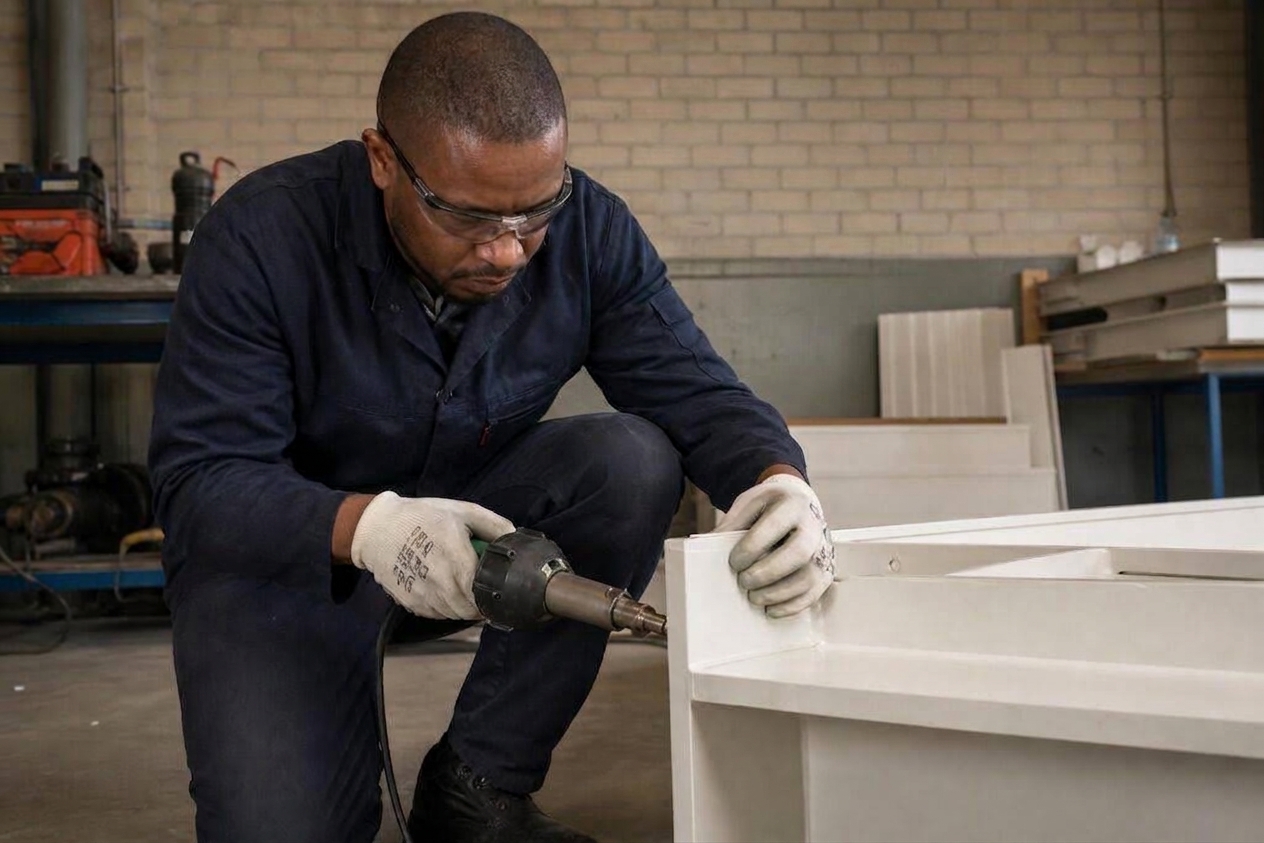
Industrial fabricators in South Africa ensure quality standards for PVC plastic welding by adhering to international DVS guidelines, using calibrated temperature-controlled equipment, and conducting rigorous non-destructive and destructive weld testing. Because unplasticised and modified polyvinyl chloride (PVC-U and PVC-C) materials are widely deployed across local mining operations, chemical processing plants, and water treatment infrastructure, maintaining structural weld integrity prevents catastrophic environmental leaks and expensive plant downtime.
Adhering to International Welding Standards and Protocols
South African plastic fabrication workshops commonly align their fabrication and welding procedures with German DVS (Deutscher Verband für Schweißen) standards, specifically DVS 2207 and DVS 2209. These codes specify the exact heating temperatures, joint preparation angles, and cooling cycles needed to achieve optimal molecular fusion without degrading the PVC compound. Fabricators verify these parameters carefully before striking an arc or feeding a welding rod.
Understanding material compatibility is equally vital when selecting which welding is used for plastic components, as rigid PVC requires different thermal input compared to polyolefins like HDPE or polypropylene. Standard quality assurance protocols follow several strict operational controls:
- Scraping and chemical cleaning of parent materials immediately before welding to remove oxidation layers.
- Monitoring ambient temperature and relative humidity to avoid rapid quenching in cold highveld winters.
- Standardising v-groove and double-v root gap preparation using dedicated mechanical profiling tools.
- Enforcing strict welder certification records according to SANS and DVS welder qualification codes.
Equipment Calibration and Environmental Control
Welding PVC demands tight thermal regulation because overheating causes thermal degradation and hydrochloric acid outgassing, while underheating results in cold, brittle joints. Leading fabrication yards utilise modern, digitally controlled hot-air tools and extrusion welders that continuously log thermal and air-volume output.
Managing South African Operating Conditions
Local workshops frequently face unique production hurdles, including utility power fluctuations and extreme summer heat. Power instability from regional load-shedding or generator switchovers can cause voltage drops that alter heating element output. Quality fabricators counter this by deploying regulated power conditioning units alongside industrial plastic welding machines featuring onboard closed-loop temperature sensors.
Reliable workshops implement clear equipment upkeep checklists to guarantee continuous process repeatability:
- Daily nozzle inspections to clear carbonised plastic residues and prevent airflow constriction.
- Routine thermocouple calibration against external digital pyrometers.
- Checking compressed air supply lines for oil, water, and particulate filtration.
Testing and Verification Methods for PVC Welds
Quality assurance is only as reliable as the verification methods used once the joint cools. Fabricators run both continuous non-destructive examination (NDE) on finished vessels and destructive sample testing during production setup to confirm joint efficiency.
Non-Destructive Testing Methods
Visual inspection serves as the primary evaluation layer, checking for uniform weld bead formation, absence of discolouration, and complete joint penetration. For critical containment tanks and chemical ducting, technicians run high-frequency spark testing (dielectric testing) along the joint line to detect microscopic pinholes, voids, or inclusions that visual checks miss.
Destructive Mechanical Testing
Before launching major production runs, fabricators weld test coupons under identical shop conditions to verify the mechanical strength of the seam:
- Tensile creep testing to confirm weld strength factors match or exceed engineering specifications.
- Bend testing across the root and face to reveal internal cracking or lack of side-wall fusion.
- Peel and shear testing on overlap joints to check continuous molecular bonding.
Precision Engineering Solutions With Plastek
Maintaining high fabrication standards requires the right combination of certified technical skill, robust materials, and precise machinery. Plastek supplies industry-tested equipment and technical expertise to help South African workshops maintain absolute consistency across every fabrication run. Whether you are building acid storage tanks, water purification scrubbers, or specialised ventilation lines, partner with experienced plastic welding professionals to ensure your installations perform reliably under demanding industrial conditions. Reach out to our team today by clicking the button below to get a quote, request a brochure, or find the perfect tool for your next project.
FAQs
What temperature is required to weld rigid PVC?
Rigid PVC (PVC-U) hot-air welding typically requires an air stream temperature between 280 and 320 degrees Celsius at the nozzle exit, depending on the welding method, tip design, and ambient shop temperature.
Why is spark testing used on PVC plastic welds?
Spark testing uses high-voltage, high-frequency electrical currents to locate micro-pores, cracks, and incomplete root fusion. Because PVC is an electrical insulator, any gap or flaw allows the current to ground against a conductive backing strip or liquid, creating a visible spark.
How does power instability affect plastic weld quality?
Voltage drops cause hot-air heating elements and extrusion preheat zones to cool rapidly below the required melt temperature, resulting in weak, unbonded cold welds that fail under mechanical pressure.
Can PVC be welded directly to other plastics like polypropylene?
No, PVC cannot be welded to dissimilar plastics like polypropylene or polyethylene because their chemical structures and melting temperatures are incompatible, preventing molecular chain entanglement.
