

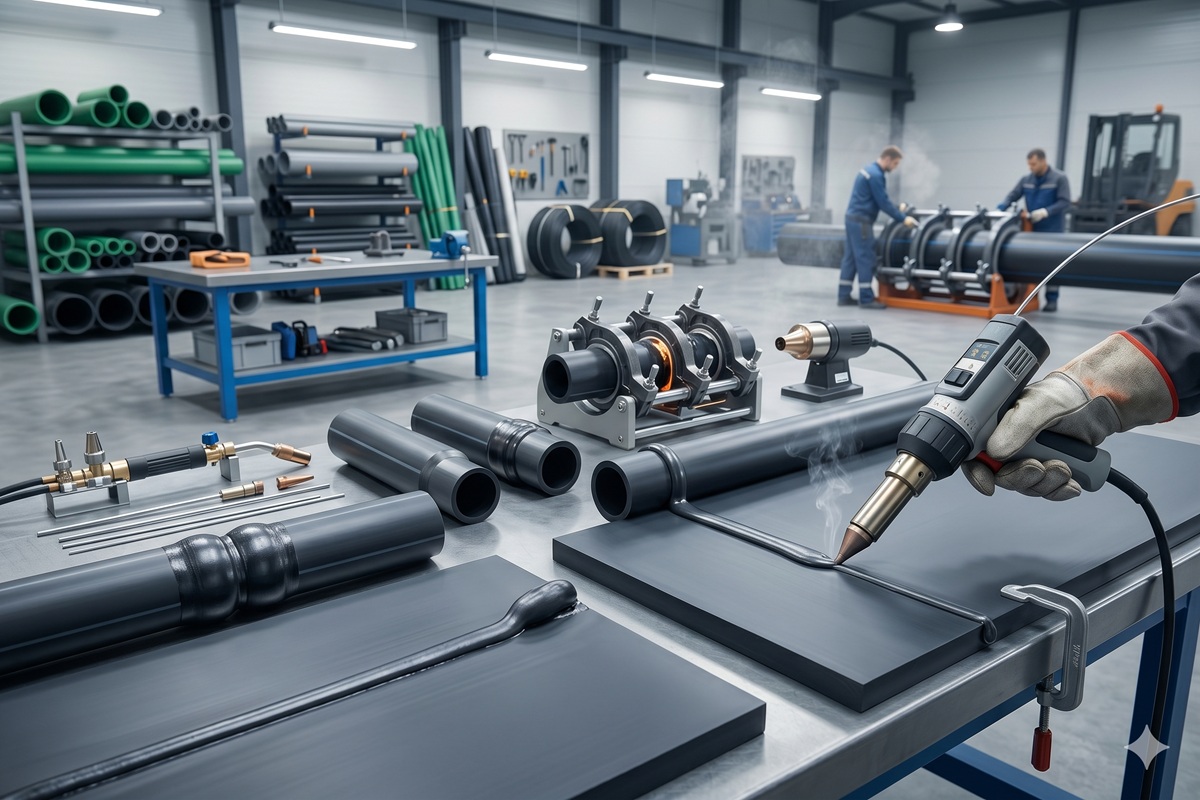
Industrial failures like leaking tanks and ruptured pipelines often stem from choosing the wrong plastic welding technique. Selecting the correct method is vital for the safety, longevity, and financial viability of high-value assets in sectors like mining and water treatment.
A professional weld can last decades, whereas a poor one may fail within months. This guide explores the plastic welding technologies used in South Africa to help you protect and maintain your critical infrastructure.
Why Choosing the Right Plastic Welding Method is Essential
The integrity of plastic fabrication depends entirely on the quality of its seams and the chosen welding technique. A correct weld creates a monolithic bond as strong as the parent material, ensuring leak-proof performance and maximum structural integrity.
Conversely, an incorrect weld creates a weak point prone to catastrophic failure and environmental contamination. This choice directly impacts your project’s operational success, safety hazards, and overall risk profile.
The Core Plastic Welding Techniques Used in South Africa
While there are many specialised methods, four techniques form the backbone of most industrial plastic fabrication projects across the country. Understanding what they are and when to use them is key.
Hot Gas Welding
Think of this as the most versatile and detailed method in our toolkit. Hot gas welding uses a specialised hand-held heat gun that directs a jet of hot air or gas to heat both the parent plastic and a separate plastic filler rod. The operator applies gentle pressure to the rod as it melts, fusing it into the joint to create a strong bond.
- When should you use it? This technique is ideal for intricate work, fabricating corners, welding in tight spaces, and performing on-site repairs. It offers precision and control that other methods can’t match.
- Common Applications in SA: Repairing cracks in polyethene water tanks, fabricating detailed fittings for chemical processing plants, and custom work on smaller thermoplastic components.
Speed Welding
As the name suggests, speed welding is a faster evolution of hot gas welding. It uses a similar hot gas tool but is fitted with a special “speed tip” nozzle. This nozzle heats the parent material and pre-heats the filler rod simultaneously, allowing the operator to move much faster along a seam while applying consistent pressure.
- When should you use it? Speed welding is the go-to method for long, straight, and accessible seams where efficiency is important. It significantly increases production speed without sacrificing quality on the right applications.
- Common Applications in SA: Welding seams on dam or reservoir liners, fabricating long, straight sections of ducting, and joining panels for flooring or wall cladding.
Extrusion Welding
For heavy-duty applications, extrusion welding is the undisputed champion. This process uses a large, powerful handheld welding machine that contains a miniature extruder. The machine grinds up plastic filler rod, melts it, and forces it out as a large, uniform bead of molten material. At the same time, a nozzle directs hot air onto the parent material to prepare it for the bond.
- When should you use it? You must use extrusion welding when joining thick materials (typically over 6mm). It lays down a large amount of filler material, creating exceptionally strong, structural welds capable of withstanding immense pressure and stress.
- Common Applications in SA: Fabricating large-diameter HDPE pipes, constructing robust chemical storage tanks, joining thick geomembrane liners for landfills and mining operations. This is a core process for heavy industrial plastic fabrication.
Butt Fusion Welding
Butt fusion is a highly reliable technique used almost exclusively for joining pipes end-to-end. The process involves placing two pipe ends into a specialised machine. A heating plate is then inserted between them, melting the ends to a precise temperature. The plate is removed, and the two molten ends are pressed together under controlled pressure until they cool, forming a permanent, leak-proof joint.
- When should you use it? This is the standard and most effective method for creating long, continuous thermoplastic pipelines. A correctly performed butt fusion joint is as strong as the original pipe, with no internal obstruction to impede flow.
- Common Applications in SA: Municipal water and gas distribution networks, agricultural irrigation systems, and pipelines for slurry and process fluids in the mining industry.
The Plastek Difference: Expertise in Plastic Fabrication Techniques SA
Understanding welding types is only the first step; certified skills, calibrated equipment, and decades of experience are what ensure success. At Plastek, we don’t just perform a weld; we engineer solutions tailored to South Africa’s specific industrial demands.
Our expertise ensures every seam meets the highest safety standards, whether requiring precision hot gas or high-strength extrusion welding. Contact us today to discuss how our specialized plastic fabrication can protect your critical infrastructure and investment.
FAQs
What is the strongest type of plastic weld?
For joining thick sheets and creating structural bonds, extrusion welding is generally considered the strongest. For joining pipes, a properly executed butt fusion weld creates a joint that is as strong as the pipe itself, making it exceptionally robust.
Can you weld all types of plastic?
No. Welding is only possible with a group of plastics called thermoplastics (like HDPE, PVC, Polypropylene). These materials can be repeatedly melted and cooled without degrading. Thermoset plastics, which undergo a permanent chemical change when heated, cannot be welded.
How long does a plastic weld last?
A plastic weld performed correctly by a certified technician should last the entire service life of the parent material. The weld is not a point of weakness; it becomes an integral part of the structure. Factors like UV exposure and chemical contact will affect the entire product, not just the weld.
What equipment is needed for plastic welding?
Each technique requires specialised equipment. This can range from a handheld hot gas tool with various nozzles to a large extrusion welder or a hydraulic butt fusion machine. Proper preparation tools like scrapers, clamps, and pipe cutters are also essential for a quality result.
Is plastic welding better than using adhesives or glues?
For structural applications involving thermoplastics like HDPE and Polypropylene, welding is far superior. Welding creates a homogenous, molecular bond by fusing the materials together. Adhesives, by contrast, create a surface-level bond between two separate materials, which can degrade over time, especially when exposed to chemicals or stress.
