

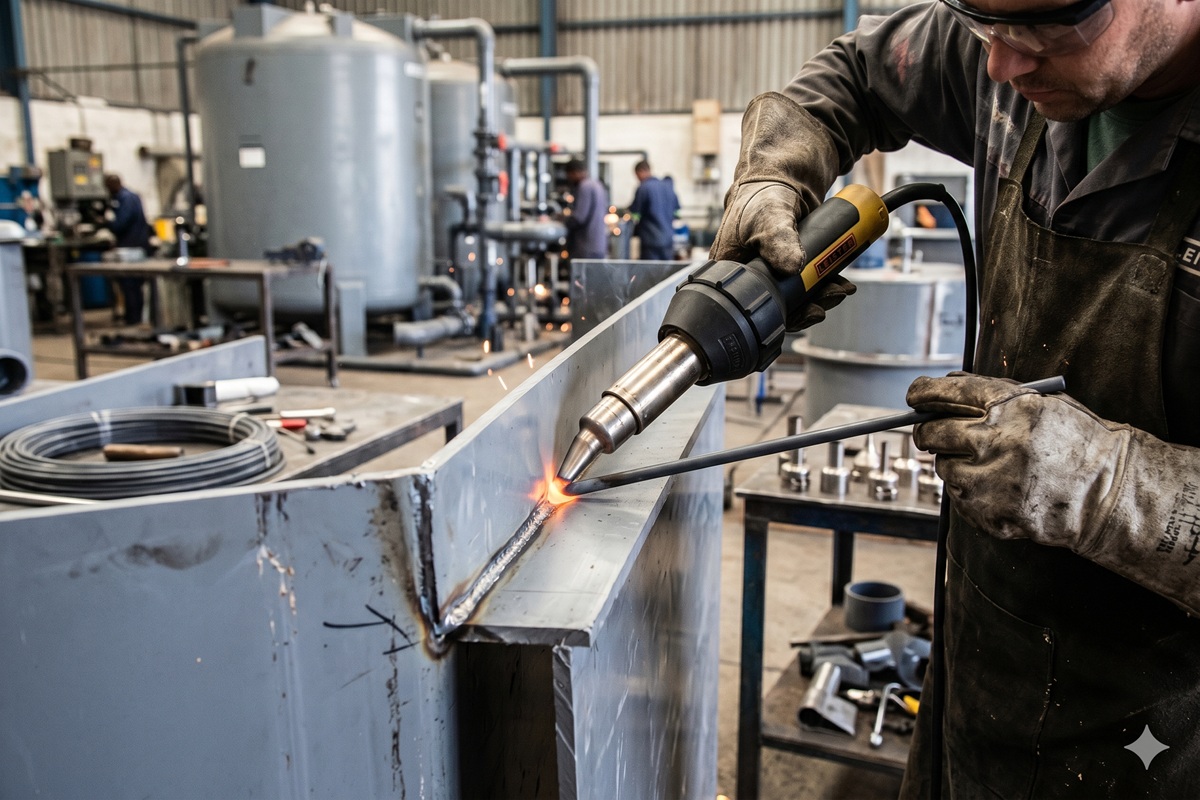
A failed PVC seam can cost South African plants millions in downtime and cleanup. For high-stress industrial use, professional welding provides a permanent, monolithic bond that adhesives simply cannot match.
If you manage PVC structures, understanding these essential welding principles is vital for safety. This guide explores the techniques and methods required to ensure maximum structural longevity in demanding environments.
What Exactly is PVC Welding?
PVC welding uses heat and a welding rod to fuse Polyvinyl Chloride pieces into a single, homogenous unit. Unlike gluing, this process melts the materials together to ensure a permanent, seamless bond.
By making separate components one, the resulting seam offers superior resistance to chemicals and pressure. This technique creates a joint that is often stronger than the original material itself.
The Critical Showdown: PVC Heat Welding vs. Solvent Welding
While both methods join PVC, they serve fundamentally different purposes. Selecting the incorrect technique for industrial applications can lead to premature structural failure. For professional rigid PVC fabrication or chemical tank repair, hot air heat welding is the only reliable method to ensure long-term integrity.
- Heat Welding (Hot Air): The industrial gold standard for structural fabrication and chemical tank repair; it uses a specialized heat gun and rod to create a monolithic bond that is often stronger than the parent material.
- Heat Welding Capability: It is the only reliable method for joining thick, rigid PVC sheets (5mm and thicker) that require maximum chemical and pressure resistance.
- Solvent Welding (Chemical): A faster, surface-level bonding method ideal for low-pressure pipework, irrigation, and small-scale fittings where high structural stress is not a factor.
- Solvent Welding Limitation: Because the chemical solvent cannot penetrate deeply into the plastic, it is ineffective for thick sheets and can become a point of weakness in demanding industrial environments.
The Toolkit: Essential Equipment for Professional Hot Air PVC Welding
Achieving a perfect weld requires the right tools. Investing in quality equipment from the start prevents costly failures down the line.
- Hot Air Welding Gun: The core of your kit. A professional-grade gun offers precise temperature control, which is essential for working with different PVC thicknesses.
- Welding Nozzles: Different profiles are used for specific tasks. A tacking nozzle is used for initial positioning, while a speed welding nozzle allows for rapid, consistent laying of the welding rod.
- PVC Welding Rods: These must match the parent material exactly. Using a different grade of PVC rod will result in a weak, unreliable weld.
Mastering the Technique: A Step-by-Step Guide to Hot Air Welding
Successful PVC welding relies on combining meticulous preparation with precise execution.
- Preparation: Clean and dry all surfaces, then bevel edges into a “V” groove to ensure deep weld penetration.
- Temperature: Set your heat gun between 280°C and 320°C to ensure proper fusion without burning the material.
- Tacking: Use a tacking nozzle to fuse the pieces at intervals, securing the structure’s alignment for the final pass.
- Main Weld: Use a speed nozzle to apply the rod with firm pressure, maintaining a steady pace to create a visible “bow wave” of fusion.
Industrial Applications in South Africa: Where PVC Welding Excels
Across South Africa’s key industries, from mining in the North West to chemical processing in Sasolburg, PVC welding is indispensable.
- Chemical Processing and Storage: For building and repairing tanks, bunds, and containment vessels that hold aggressive acids and alkalis. The seamless nature of a weld prevents leaks.
- Water and Wastewater Treatment: Fabricating large-diameter pipes, clarifiers, and scrubbers that can withstand constant exposure to corrosive materials.
- Mining and Extraction: Creating durable ventilation ducting, electroplating tanks, and slurry pipes that can handle abrasive and chemical-heavy environments.
Why Your Weld Fails: Common Mistakes to Avoid
I have seen many projects fail due to simple errors. Avoid these common pitfalls to ensure your work stands the test of time.
- Incorrect Temperature: The single biggest cause of failure. Always perform a test weld on a scrap piece to verify your settings.
- Insufficient Pressure: The welding rod must be firmly pushed into the molten seam to displace all air and ensure a complete fusion.
- Contamination: Any dust, grease, or moisture on the welding surfaces will create a weak spot in the finished seam. Cleanliness cannot be overstated.
Choosing Your Partner for PVC Supplies and Expertise
Successful projects require both expert technique and high-quality materials from a technically-minded supplier. The integrity of any rigid PVC fabrication relies on using certified, top-grade sheets and perfectly matched welding rods.
Plastek provides the South African industry with premium materials, professional equipment, and essential technical support. Our team ensures your projects meet the highest safety standards through expert guidance on material selection and welding.
Ensure Your Project’s Integrity with Plastek
Ready to elevate your industrial fabrication? Don’t leave your structural integrity to chance; contact the experts at Plastek today to secure the high-grade PVC materials and professional welding equipment your South African facility demands. Whether you need technical advice on material selection or are ready to stock up on certified welding rods, our team is standing by to help you achieve a flawless, permanent bond for your next project.
FAQs
How strong is a PVC weld?
A correctly executed hot air PVC weld is exceptionally strong. When tested to destruction, the parent material will typically fail before the welded seam does. It creates a permanent, monolithic bond that restores the original strength of the material.
Is PVC welding waterproof?
Yes, absolutely. Because the process fuses the plastic into a single, continuous piece, a proper PVC weld is completely impervious to water and most chemicals. This is why it is the required method for building chemical and water tanks.
Can you weld all types of PVC?
You must weld like-for-like materials. Rigid PVC (PVC-U) sheets must be welded with a rigid PVC welding rod. Flexible PVC requires a flexible PVC rod. Attempting to mix types will result in a failed bond as their chemical compositions and melting points differ.
What is the best temperature for hot air plastic welding of PVC?
For rigid PVC, the ideal welding temperature is generally between 280°C and 320°C. However, this can vary slightly based on the material thickness, ambient temperature, and welding speed. Always conduct a trial weld on a piece of scrap material first.
Do you need a special rod for PVC welding?
Yes, using the correct welding rod is non-negotiable. The rod must be made from the exact same type of plastic as the sheets you are joining. At Plastek, we can supply the precisely matched welding rod for any PVC sheet we sell.
