

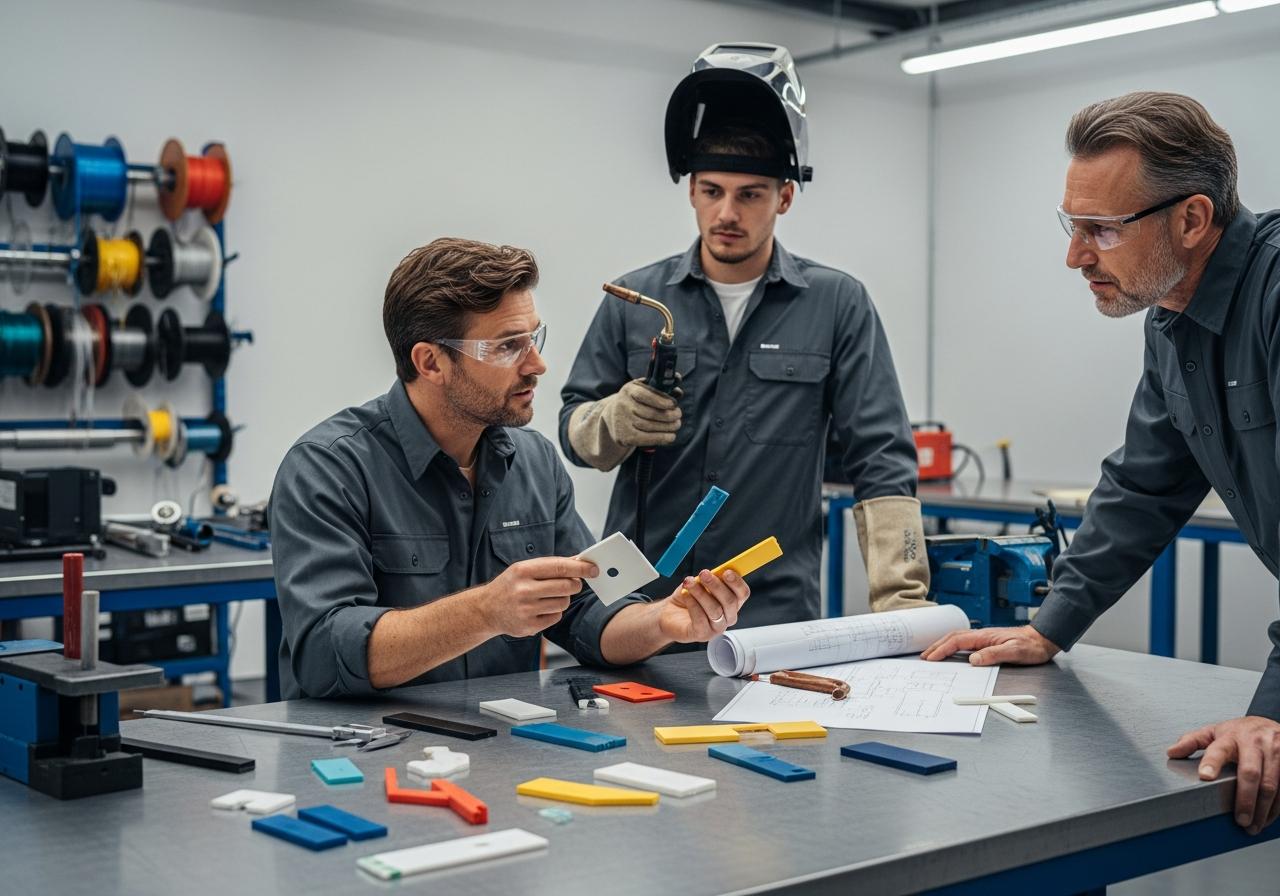
Selecting the wrong plastic for welding guarantees a complete failure, wasting both time and money. Since not all materials are created equal, understanding which specific plastics can be reliably fused is essential for a seamless structure.
This guide explores common weldable plastics to help you make informed decisions for South African-based projects. From tank fabrication to pipeline repairs, proper material selection ensures your thermoplastic fabrication remains secure.
Understanding Weldable Thermoplastics
A fundamental concept in fabrication is that only thermoplastics can be welded. These polymers become pliable when heated and solidify upon cooling, a reversible process that allows edges to fuse on a molecular level into a single, solid structure.
Conversely, thermoset plastics undergo a permanent chemical change when heated and will burn rather than melt. Because they cannot be reshaped or fused, they are impossible to weld, making thermoplastics the only choice for welding projects.
The Top Contenders for Plastic Welding
Three thermoplastics dominate the industry for their performance, cost-effectiveness, and weldability:
- HDPE: A durable workhorse with high impact and UV resistance, ideal for pipelines and outdoor use.
- Polypropylene (PP): Lightweight and rigid with superior chemical and heat resistance, perfect for harsh industrial tanks.
- PVC: A fire-retardant, versatile material commonly used for ducting and electrical enclosures.
HDPE vs Polypropylene: The Most Common Welding Dilemma
Choosing between HDPE and Polypropylene depends entirely on your project’s needs: PP offers the superior rigidity required for self-supporting structures, while HDPE provides the flexibility and impact strength necessary to withstand physical stress or ground movement.
- Temperature Resistance: PP has a higher service temperature than HDPE, making it suitable for applications involving hot liquids or steam sterilisation.
- UV Resistance: Natural PP has poor UV resistance. While additives can help, black HDPE is inherently better suited for long-term, direct sun exposure common in our climate.
- Chemical Resistance: Both are excellent, but PP often has a slight edge against specific organic solvents and acids where HDPE might falter.
The best approach is to analyse the specific chemicals, temperatures, and physical stresses your project will face to determine the most suitable material.
The Golden Rule: You Cannot Weld Dissimilar Plastics
This is the most important takeaway for achieving high-strength plastic bonds. You cannot weld HDPE to Polypropylene. You cannot weld PVC to HDPE. You must weld like-to-like.
The welding process relies on the intermingling of polymer chains. Different plastics have different chemical structures, melting points, and flow rates. Attempting to fuse them is like trying to mix oil and water; they simply will not form a permanent, molecular bond. Always use a welding rod made of the exact same material as the parts you are joining.
How to Identify Your Plastic
If you are repairing an existing item, you need to identify the plastic correctly. Here’s a simple way to check:
Look for the plastic identification code (the recycling symbol).
- #2 is HDPE
- #5 is PP
- #3 is PVC
If there is no code, a small burn test can be performed by a professional in a well-ventilated area, as the smoke and smell are distinct for each polymer. However, for guaranteed results, it’s always best to consult with an expert.
Making the Right Choice for Your Project
Choosing the right plastic is foundational for successful fabrication, as HDPE, PP, and PVC each serve distinct roles. HDPE offers outdoor toughness, PP provides rigid chemical resistance, and PVC is ideal for specialist ducting and enclosures.
Always follow the golden rule of welding like-to-like materials to avoid costly failures. For expert advice and high-quality results for your next project, contact the Plastek team today to ensure a long-lasting, reliable bond.
FAQs
What is the strongest type of plastic weld?
For thick materials like HDPE and PP sheets used in tank and pipeline fabrication, extrusion welding typically produces the strongest bond. This method uses a large-volume extruder to lay down a substantial bead of molten plastic, ensuring deep penetration and a robust, structural seam.
Can you weld any two plastics together?
No. It is a fundamental principle of plastic welding that you can only create a strong, permanent bond by welding “like-to-like” materials. For example, you must use a Polypropylene welding rod to join two sheets of Polypropylene. Welding dissimilar plastics will result in an immediate or eventual bond failure.
How can I tell if a plastic is weldable?
First, identify if it’s a thermoplastic. A quick way is to check the recycling code. Plastics with codes #2 (HDPE), #3 (PVC), #4 (LDPE), #5 (PP), and #6 (PS) are all thermoplastics. If the material chars and burns without melting when heat is applied, it is likely a thermoset and cannot be welded.
Is HDPE or PP better for outdoor use in South Africa?
Black, carbon-filled HDPE is significantly better for long-term outdoor use than Polypropylene. The carbon black acts as a powerful UV stabiliser, preventing the plastic from becoming brittle and degrading under the intense South African sun. While PP can be stabilised, HDPE is the standard for durable outdoor applications.
Why is my plastic weld failing or cracking?
Weld failure is almost always due to one of three issues: incorrect material identification (welding dissimilar plastics), improper surface preparation (failure to clean or abrade the surface), or incorrect welding parameters (wrong temperature or speed). All three can be avoided by following correct procedures and consulting with experienced fabricators.
