

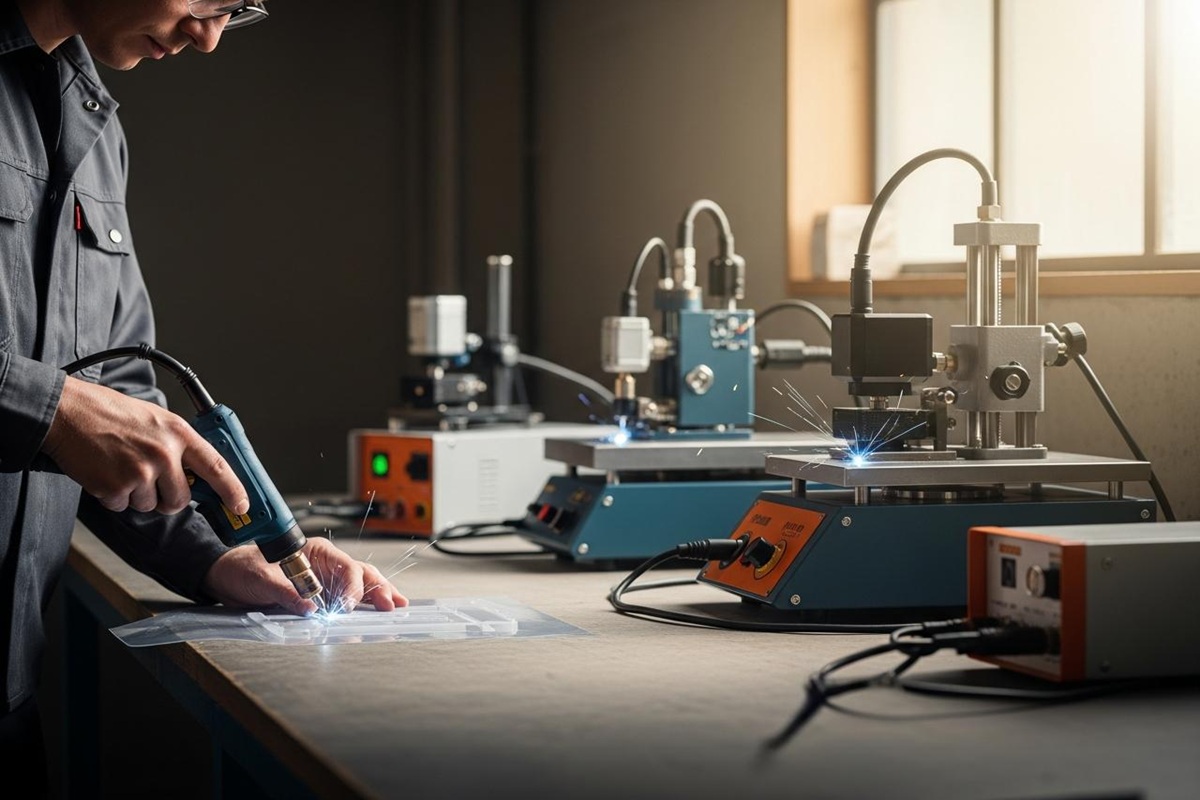
Choosing the wrong plastic welder is a costly mistake, leading to wasted materials and failed projects that hurt your bottom line. As a local expert, I’ve seen how the right equipment separates success from failure.
This guide provides clarity on the primary types of machines and where they excel. I’ll help you select the perfect fit for your specific application, from Gauteng plants to Northern Cape mines.
Why Your Choice of Plastic Welder Matters
Success in plastic welding depends on the “welding triangle”: temperature, pressure, and time. The right equipment gives you precise control over these factors, while the wrong choice leads to guesswork and failure.
A proper machine ensures:
- Weld Strength: Creating permanent bonds as strong as the parent material.
- Efficiency: Matching production speed to your specific volume needs.
- Compliance: Meeting safety standards and strict industry regulations.
A Breakdown of the Main Types of Plastic Welding Machines
Plastic welders are not a one-size-fits-all solution. They are specialised tools. Let’s look at the most common categories you will encounter.
Hot Air Welders (Including Hand-Held Welders)
Hot air welders are the most versatile category, using a heating element and blower to melt surfaces and fuse them with a filler rod.
The portable hand-held welder is the industry standard for on-site repairs and detailed work like geomembrane liners. It offers technicians high precision for custom fabrication and maintenance.
- Best for: On-site repairs, roofing, tarpaulins, and flooring.
- Materials: Versatile use with PVC, HDPE, and PP.
Extrusion Welders
The professional standard for joining thick sheets, extrusion welders use a built-in extruder to heat and mix a welding rod. They deposit a large bead of molten material directly into the seam for a structural finish.
By preheating the parent material with a hot air nozzle, these machines create deep, homogenous bonds quickly. They are essential for heavy-duty projects requiring maximum weld strength.
- Best for: Heavy-duty fabrication, sheets thicker than 6mm, and tank construction.
- Materials: Primarily used for HDPE and PP.
High-Frequency Welders
High-frequency welders use electromagnetic fields instead of external heat to excite polar molecules within the plastic. This causes the material to heat rapidly from the inside out before pressure fuses them together.
This process is incredibly fast and consistent, producing clean, strong welds without unsightly heat marks. It is specifically designed for materials with dielectric properties.
- Best for: High-volume production of PVC banners, medical bags, and inflatables.
- Materials: Primarily PVC, PU, and other polar polymers.
Automated Welding Benches and Butt Fusion Machines
For high-volume production, automated welding benches provide the precision and repeatability needed for flawless straight-line welds.
Butt fusion and orbital welding are the industrial standards for joining pipes. By heating and pressing perfectly smooth pipe ends together under controlled pressure, these machines create permanent, leak-proof joints essential for South African infrastructure.
- Best for: Manufacturing lines, gas and water pipe installations, and large-scale industrial projects.
- Materials: HDPE and PP for piping; various thermoplastics for bench welding.
How to Choose the Right Machine for Your Business
To select the right machine, you need to analyse your primary needs. I always advise my clients to consider these four points:
- Material Type: What specific thermoplastics will you be working with? A high-frequency welder for PVC is useless if your core business is HDPE tanks.
- Application and Environment: Will you be in a workshop or on a remote site? The portability of a hand-held welder is essential for field repairs.
- Production Volume: Are you doing one-off custom jobs or thousands of repetitive welds? Your answer will point you toward manual tools or automated benches.
- Thickness of Material: Hand-held welders are great for thinner sheets, while extrusion welders are non-negotiable for thick, structural applications.
Making an informed decision based on these factors will provide a far better return on investment than simply choosing the cheapest option.
Let Plastek Help You Make the Right Choice
Selecting the right type of plastic welding machine is a foundational decision for any business in the fabrication industry. By understanding how each machine works and aligning its capabilities with your specific applications, you ensure every weld is strong, efficient, and profitable.
If you are navigating this decision for your South African business and need expert guidance, my team at Plastek is here to help you analyse your needs and match you with the most effective equipment.
FAQs
What is the strongest plastic welding method?
For thick materials like HDPE, extrusion welding typically produces the strongest structural welds due to the large volume of filler material and excellent fusion. For pipes, butt fusion creates a joint that is as strong as the pipe itself.
Can all types of plastic be welded?
No. Only thermoplastics can be welded. These are plastics that can be repeatedly softened by heating and hardened by cooling. Thermoset plastics, which undergo a chemical change when heated, cannot be re-melted and welded.
Is plastic welding as strong as metal welding?
When performed correctly on the right material, a plastic weld creates a permanent molecular bond. For many applications, the weld area can be just as strong, or even stronger, than the original material surrounding it.
What is the easiest plastic welder to use for a beginner?
Hot air hand-held welders are generally considered the most accessible for beginners to learn basic plastic repair and fabrication techniques, although mastering them requires significant practice to produce consistent, high-quality welds.
How much does a plastic welding machine cost in South Africa?
The price varies enormously. A basic hand-held hot air tool might cost a few thousand Rand, while a large industrial butt fusion machine or an automated welding bench can cost hundreds of thousands of Rand. Your investment should match the scale and requirements of your business.
