

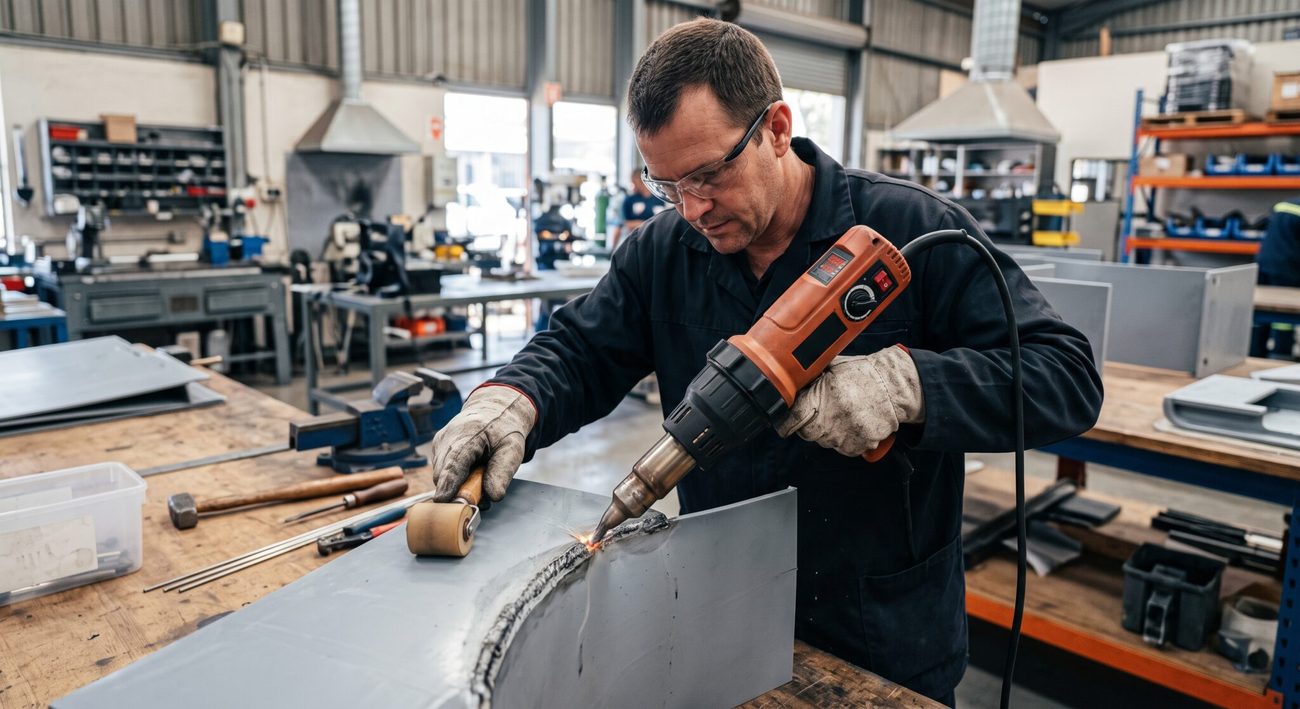
When sourcing hot air plastic welding tools from Johannesburg suppliers for commercial projects, your priorities must be precise digital temperature controls, independent airflow adjustment, heavy-duty heating elements, and robust protection against local voltage fluctuations. These engineering specifications ensure that your equipment can withstand the demanding conditions of South African construction sites while delivering high-strength welds on materials like HDPE, PP, and PVC.
Selecting Commercial-Grade Features for High-Strength Welding
Commercial thermoplastic fabrication requires equipment that maintains absolute consistency under continuous usage. In Johannesburg, where projects are often fast-paced and subject to temperature shifts, manual adjustments must be quick and precise. Opting for tools with a digital readout lets your team monitor the actual weld temperature in real time, preventing weak seams that fail quality checks. For high-volume jobs, investing in premium tools ensures that your operators can work efficiently without overheating the equipment.
A professional-grade hot air tool should have these key mechanical attributes:
- Closed-loop electronic heating systems that automatically adjust power to maintain set temperatures.
- Ergonomic, non-slip handles that reduce hand strain during long shifts.
- Easily accessible air filters that protect the internal motor from fine plastic shavings and dust.
Mitigating South African Power Challenges on Site
Operating commercial machinery in Gauteng comes with unique challenges, particularly regarding electrical consistency. Power fluctuations, sudden voltage drops, and reliance on site generators can easily fry delicate electronics in sub-par equipment. Selecting tools built with robust internal components and thermal overload protection is essential. This durability prevents costly downtime and keeps your fabrication timeline on track.
Generator-Friendly Heating Elements
When running your tool on a mobile generator, ensure the heating element has high thermal shock resistance. Standard elements easily crack when power drops or spikes, whereas ceramic-protected elements absorb these shifts without burning out.
To ensure your tools survive the realities of remote South African construction sites, look for the following specifications:
- A robust power cord with heavy-duty strain relief to withstand being dragged across rough concrete floors.
- An automatic cooling phase that runs the blower after shut-off to protect the ceramic element.
- A brushless motor design that reduces maintenance overhead and increases tool lifespan.
Matching Equipment with the Right Thermoplastic Material
Not all plastics behave the same way under heat. Understanding which welding is used for plastic projects on your schedule is the first step toward choosing the right system. While thin PVC sheets respond well to rapid heat transfer, thick HDPE panels require constant pressure and a sustained temperature soak to achieve molecular fusion. Using a mismatched tool can lead to superficial bonds that look correct but fail under pressure.
Different projects require specific accessory compatibility:
- High-speed welding nozzles for rapid fabrication of polypropylene tanks and containers.
- Draw welding tips that feed the welding rod directly into the joint for even heat distribution.
- Tacking nozzles to temporarily secure large components before executing the structural seam.
Scaling Up to Automated Systems for Infrastructure Projects
For massive projects such as geomembrane liners, large roofing installations, or high-volume pipe fabrication, manual hot air blowers might not suffice. For these extensive jobs, utilising industrial plastic welding machines is necessary to guarantee absolute uniformity across kilometres of seams. Automated welders regulate speed, pressure, and heat automatically, removing human error from the equation.
Automated systems provide distinct advantages for large-scale operations:
- Integrated drive rollers that apply a continuous, consistent force along the seam.
- Onboard parameter tracking to document temperature and speed for engineering sign-offs.
- A compact footprint that allows for efficient transport between different sections of the job site.
Precision Solutions With Plastek
At Plastek, we supply high-quality plastic welding equipment designed to meet the toughest industrial demands in South Africa. As an authorised distributor of BAK Technology AG solutions, we provide rugged, Swiss-engineered hot air tools and automatic welders that handle voltage fluctuations and intensive workloads with ease. To find the right equipment or to get a custom quote, reach out to our team today by clicking the button below.
FAQs
What is the ideal temperature range for welding HDPE?
For most HDPE projects, the hot air temperature should be set between 280 degrees Celsius and 320 degrees Celsius, depending on the ambient air temperature and the thickness of the material. It is vital to use a tool with digital controls to maintain this range precisely.
Can I run a hot air plastic welder on a generator?
Yes, but you must ensure the generator has a stable voltage regulator (AVR) and sufficient wattage output. Fluctuations in generator power can damage the tool’s electronic circuit board and burn out the heating element. Using high-quality tools with built-in voltage protection is recommended.
How often should I clean the air filters on my welding tool?
In dusty commercial environments, clean the air filters daily. Clogged filters restrict airflow, causing the heating element to overheat and burn out prematurely. Simple regular maintenance will extend the life of your equipment significantly.
What is the difference between speed welding and hand welding?
Hand welding involves manually feeding a welding rod into the groove while heating it with a basic nozzle, which is slower and requires high operator skill. Speed welding uses a specialized nozzle that guides, heats, and presses the welding rod into the joint simultaneously, greatly increasing productivity and consistency on commercial projects.
